

Most articles on this topic hand you the same list of directories and tell you to "stay consistent." That advice is fine, and it is also why so many firms build 60 citations and watch their Map Pack ranking sit exactly where it started. Citations still work. The order you build them in, and the shape each one takes, is what separates a firm that climbs from a firm that just has listings.
We run SEO for law firms at Constellation, and citation work is one of the first things we touch on almost every campaign. Below is how we actually approach it, not the checklist version.
What a Local Citation Actually Is (and Why Google Cares)
A local citation is any online mention of your firm's name, address, and phone number. That trio gets its own acronym in this world: NAP. A citation can be a full directory profile on Avvo, a one-line entry in a chamber of commerce roster, or your firm's name dropped in a local news story.
There are two kinds, and the difference matters more than most guides admit.
- Structured citations live in directories built to hold business data: Google Business Profile, Yelp, Justia, FindLaw. Fixed fields, predictable format.
- Unstructured citations show up in the wild: a bar association member page, a sponsorship listing, a quote in a local paper. No template, just your NAP inside real content.
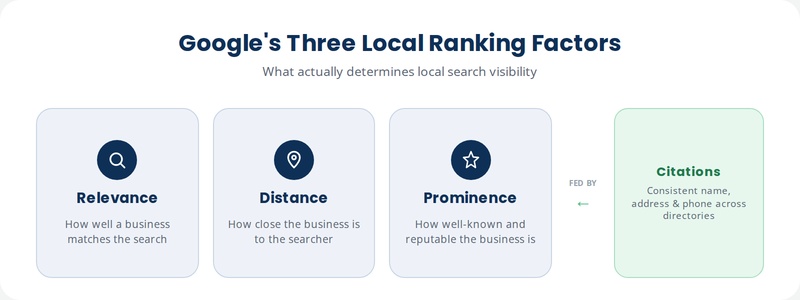
Google leans on both to answer one question about your firm: is this a real, established business in this place? Its own guidance breaks local ranking into three factors, and citations feed the third one. Relevance and distance you can only nudge. Prominence, per Google's local ranking documentation, is built partly from "information Google has about a business from across the web," which is a plain description of your citation footprint.
Citations don't rank your site by themselves. They confirm you are who your website says you are, in the place it says you are, so Google trusts everything else you do.
Audit Before You Build: Fix What's Already Broken
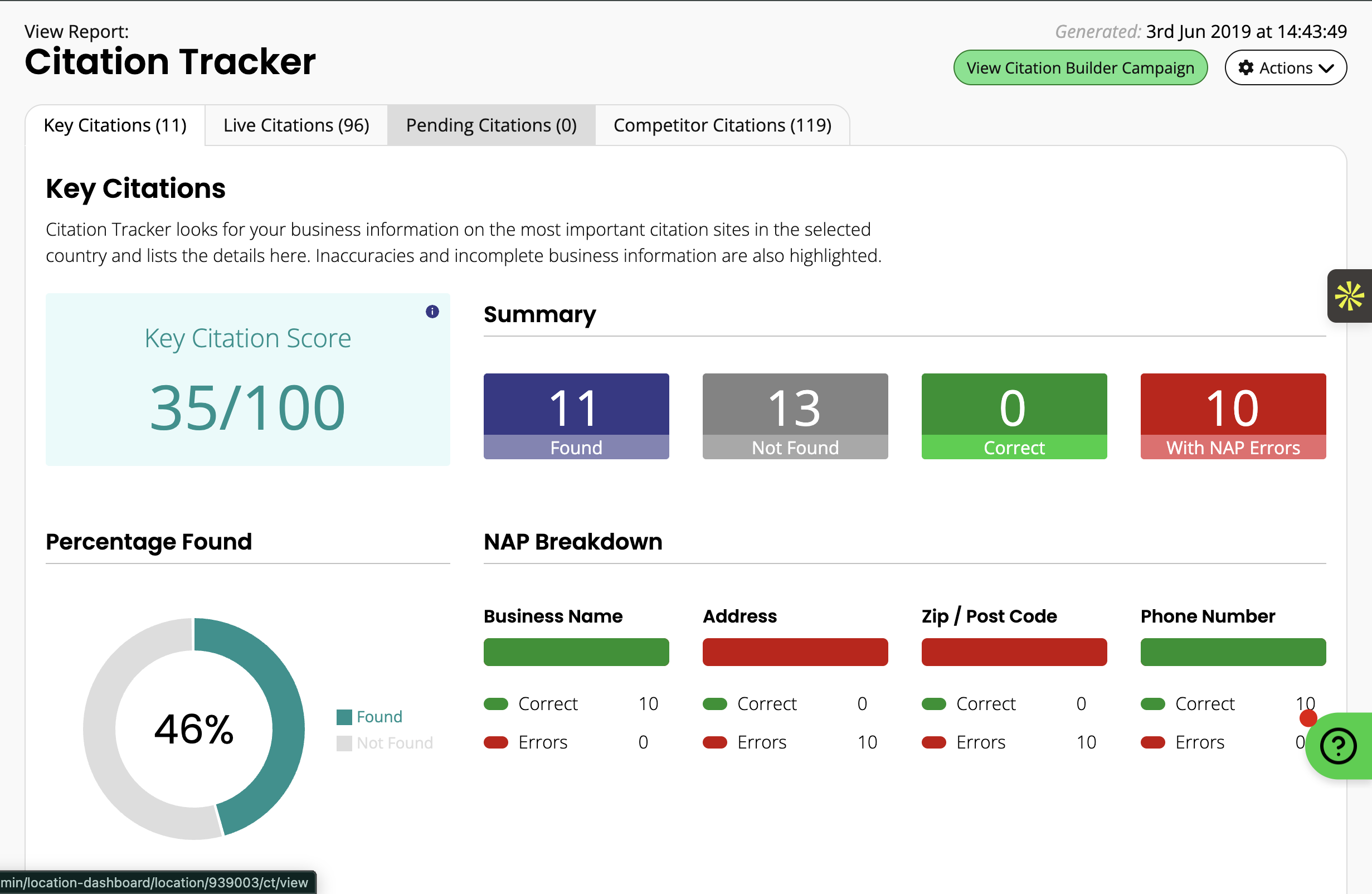
Here is the mistake I see most often. A firm hires help, and the first move is submitting to 50 new directories. Nobody checked what was already out there. So now the firm has 50 fresh listings layered on top of a decade of old ones that say "Smith & Jones, LLP" at a suite number the firm left in 2019.
Google reads that mess as ambiguity, and ambiguity is exactly what suppresses local rankings. So we audit first, every time.
Run your firm through BrightLocal, Whitespark, or Moz Local before you build anything new. Each one scans the web for existing mentions and flags where your NAP disagrees with itself. You are hunting three things:
- Wrong data. Old addresses, disconnected phone numbers, a former partner's name still on the shingle.
- Duplicates. Two Google profiles, three Yelp pages. Duplicates split your authority and confuse the ranking algorithm.
- Gaps. The high-value directories your competitors sit on and you don't.
Fix the data and kill the duplicates before you add a single new listing. Cleanup is slower and less satisfying than building, and it is usually where the ranking movement actually comes from. On established firms, we treat citation cleanup as a prerequisite, not a phase two.
One decision to make before you touch anything: lock in your canonical NAP. Pick the exact spelling, the exact suite abbreviation, the exact phone format your firm will use everywhere, forever. Write it down. Every listing from here on copies that string character for character.
Start With Google Business Profile, the Citation That Outweighs the Rest
If you fix one thing this month, fix this. Your Google Business Profile is the single most important citation you own, and it is the one Google trusts as the source of truth for everything else.
Claim it at Google Business Profile if you haven't. Then fill every field, not the three obvious ones. The fields that move the needle for law firms:
- Primary category. Match it to your core practice ("Personal injury attorney," not the generic "Legal services"). This is one of the strongest relevance signals you control.
- Secondary categories for each practice area you genuinely serve.
- Hours, service areas, and a real description written for a human, not stuffed with city names.
- Photos of the actual office and team. Stock images do nothing here.
Your GBP NAP becomes the reference point. Every other citation you build should match it exactly. When your profile and your directory listings disagree, Google believes the profile and distrusts the rest. If your profile has ever been suspended or you're wrestling with a messy listing, we walk through the recovery playbook in our guide to fixing Google Business Profile problems.
Build in Tiers: The Order That Actually Moves Rankings
This is where our approach splits from the standard listicle. We don't build citations alphabetically or by whatever the tool spits out first. We build in tiers, highest authority and relevance first, because the early citations do the heavy lifting and the long tail delivers diminishing returns.
Tier one: legal-specific directories. These carry the most weight for a law firm because they pair authority with topical relevance. Build complete profiles on the ones that matter and skip the filler. Start with Justia, Avvo, FindLaw, and Martindale-Hubbell. Super Lawyers and Nolo round out the set. Many of these are free, and we keep a working list of the strongest options in our roundup of free legal directories worth claiming.
Tier two: data aggregators. These are the wholesalers of business data. Submit to a handful and they syndicate your NAP across hundreds of downstream sites. In the United States that means Data Axle, Localeze, and Foursquare. One clean submission here cascades into dozens of accurate citations you never touch by hand. It also means one wrong submission cascades into dozens of errors, which is exactly why the audit comes first.
Tier three: general business directories. Yelp, Better Business Bureau, Apple Maps, Bing Places, Facebook. Broad reach, lower relevance, still worth having. Bing Places earns a mention beyond its traffic because it feeds some AI search tools, which is a small edge most firms ignore.
Our Industry Insight: Ten complete, consistent tier-one citations beat a hundred half-finished listings on directories nobody in your market has heard of.
Notice what this order does. It front-loads the citations Google weighs most, so you see movement earlier, and it treats the long tail as maintenance rather than the main event. For the bigger picture of how citations fit alongside reviews, on-page work, and content, our local SEO guide for law firms connects the pieces.
What a "Complete" Citation Looks Like (Our Standard)
A citation is not "done" when you paste in your name, address, and phone number. That is the floor. Half the value of a directory profile sits in the fields most firms leave blank.
When we build a listing, we hold it to a standard that goes well past NAP. Before we call one finished, it carries:
- A consistent business description that reads naturally and names the practice areas, no city-name stuffing.
- Every practice area the directory allows, mapped to how clients actually search.
- Office hours, a website link, and a booking or contact path so the profile can convert, not just exist.
- Photos where the platform supports them, because a profile with images looks legitimate to both Google and the person reading it.
- The exact canonical NAP string, down to "Ste." versus "Suite."
The reason is simple. A thin citation confirms you exist. A complete one confirms you exist, tells Google what you do, and occasionally sends a real client through the door as a referral. Same submission effort, very different return. We would rather build 40 citations to this standard than 120 that stop at the phone number.
One more standard we hold: individual attorneys get their own profiles where the directory allows it. A three-lawyer firm can legitimately maintain listings for the firm and for each attorney, which multiplies your presence in directories that many of your competitors treat as a single entry.
How Many You Need and How to Measure Impact
There is no magic number, and any article that gives you one is guessing. The honest answer is relative: you need rough parity with the firms already winning your Map Pack.
So measure them, not a generic benchmark. Pull the three firms ranking in the local pack for your money keyword and count their citations with your audit tool. If they sit on 80 to 120 consistent citations, that is your target, and quantity past that point stops mattering more than consistency does. Chasing a competitor's count is a real strategy. Chasing a round number off a blog post is not.
Pace matters too. Building 200 citations in a weekend looks unnatural, and a steady cadence over the first few months reads as a firm establishing itself the normal way. We build the tier-one and aggregator foundation up front, then fill the tail on an ongoing basis.
Now the part almost nobody does: measure the right thing. Do not celebrate the citation count. It is an input, not an outcome. Watch your ranking on a geographic grid instead, using a rank tracker that maps your position across your service area rather than from a single point. When your Map Pack position climbs across that grid over the weeks after a citation build, the work paid off. When only the citation number climbs, you built listings, not rankings.
Mistakes That Quietly Kill Citation Value
These are the errors I see drain citation work of its value, in rough order of how often they show up.
- Inconsistent NAP. "St." here, "Street" there, an old suite number somewhere else. Small to you, ambiguous to Google.
- Ignored duplicates. A second Google profile or a stray Yelp page splits your authority and can suppress the listing you actually want to rank.
- P.O. boxes instead of a physical address. Google favors real locations, and a box can undercut the whole profile.
- Building before cleaning. New citations stacked on unfixed old ones just amplify the confusion.
- Set-and-forget. Aggregators redistribute stale data, old employees update listings, duplicates reappear. Citations decay. A quarterly check catches the drift before it costs you.
None of these are exotic. They are the boring failures that separate a citation profile that supports your rankings from one that quietly works against them.
Citations are foundational, not a finish line. They earn Google's trust so the rest of your SEO, the content, the reviews, the on-page work, has something solid to stand on. If you'd rather have this handled correctly the first time instead of untangling it later, book a call with our team and we'll map out where your firm stands. You can also read more about how we work with law firms before you do.
Frequently Asked Questions
What is a local citation for a law firm?
It's any online mention of your firm's name, address, and phone number (NAP). That includes directory profiles like Avvo or Justia, general listings like Yelp, and unstructured mentions in local news or sponsorship pages. Google uses these mentions to verify your firm is a real, established business in a specific place.
Do local citations still help SEO in 2026?
Yes. Citations are no longer a growth lever on their own, but they remain a trust and verification signal that feeds the "prominence" factor in Google's local ranking. Think of them as the foundation. They won't win rankings alone, but weak or inconsistent citations will hold back everything else you do.
How many local citations does a law firm need?
There is no fixed number. The practical target is rough parity with the firms already ranking in your Map Pack. Count the citations of the top three local results for your keyword and match them. For most markets that lands somewhere between 50 and 120, but consistency matters more than raw volume.
What is the difference between structured and unstructured citations?
Structured citations live in directories built for business data, with fixed fields like Google Business Profile or FindLaw. Unstructured citations appear inside regular content, such as a bar association page or a local news article that names your firm. Both count, and a healthy profile has a mix.
Which directories are best for local citations for lawyers?
Start with legal-specific directories, since they pair authority with relevance: Justia, Avvo, FindLaw, Martindale-Hubbell, Super Lawyers, and Nolo. Then add data aggregators (Data Axle, Localeze, Foursquare) and general directories like Yelp, BBB, Apple Maps, and Bing Places.
What does NAP consistency mean and why does it matter?
NAP consistency means your name, address, and phone number appear identically everywhere online, down to abbreviations like "Ste." versus "Suite." It matters because Google treats discrepancies as ambiguity about whether listings refer to the same business, which can suppress your local rankings.
Are paid citation services worth it for law firms?
They can be, for the syndication reach of data aggregators and for saving time on manual submissions. The caveat: never buy volume before you've audited and cleaned your existing citations. Paying to distribute inaccurate NAP data just spreads the problem faster.
How long do local citations take to affect rankings?
Expect weeks, not days. Google has to discover and re-crawl the new or corrected listings, and aggregator data cascades on its own schedule. Track your Map Pack position on a geographic grid over the following one to three months rather than watching for an overnight jump.
Can I list each attorney separately on directories?
Yes, on directories that allow individual attorney profiles. A firm with three lawyers can maintain a listing for the firm plus one for each attorney, which expands your footprint in legal directories. Keep every profile's shared details consistent with your canonical NAP.
What is the most common citation mistake law firms make?
Building new citations before cleaning up the old ones. Layering fresh listings on top of outdated addresses, duplicate profiles, and disconnected numbers amplifies the inconsistency Google is trying to resolve. Audit and fix first, then build.
How do I find and fix inaccurate citations?
Run your firm through a citation tool like BrightLocal, Whitespark, or Moz Local. Each scans the web and flags where your NAP disagrees with itself or where duplicates exist. Correct the data directly on each platform, remove duplicates, and re-check quarterly since listings drift over time.