

Every few days lately, a firm owner forwards me the same pitch. New subject line, same promise. "ChatGPT ads are here. Lock in your spot before your competitors do." Sometimes it's a cold email. Sometimes it's a slick webinar invite with a countdown timer. The urgency is always the same, and the urgency is always doing the heavy lifting.
Here's the part the pitch skips. Right now, you almost certainly cannot run those ads as of August 2026. OpenAI's own published ad policy prohibits advertising for legal services, and it names the practice areas out loud. Personal injury. Immigration. Legal claims. Document preparation. If that describes your firm, the product being sold to you isn't a product you can buy.
Industry Insight: The agencies pitching ChatGPT ads for lawyers this month know you're not allowed to run them. That's the tell.
So let's read the actual rulebook. I'll show you where the eligibility line sits, why it's genuinely blurry even after you read it, and why the hype won't cool off no matter what the policy says.
The Pitch You're Getting Right Now
The pitch has a shape, and once you see it you can't unsee it. It opens with a stat about how many people now ask ChatGPT questions instead of Googling them. It pivots to "your future clients are already there." Then it lands on the close: get in during the first-mover window, before ad costs climb and the good placements are gone.
Notice what's missing. Nobody in that email is telling you whether a personal injury firm is actually permitted to advertise on the platform today. That's not an oversight. The eligibility question is the entire premise of the offer, and skipping it is how you sell urgency instead of strategy.
A first-mover window only means something if you're allowed through the door. If you're not, "get in early" is a countdown timer attached to a room you can't enter. You're not buying a channel. You're buying a pitch deck.
I've watched this movie before with every new ad platform that touched legal. The firms that win aren't the ones who move first on hype. They're the ones who move first on the actual advertising rules that govern legal marketing, then build once the rules are clear.
What OpenAI's Ad Policy Actually Says About Legal Services
You don't have to take my read on faith. The policy is public, and the legal services section is three sentences long. Here it is close to verbatim:
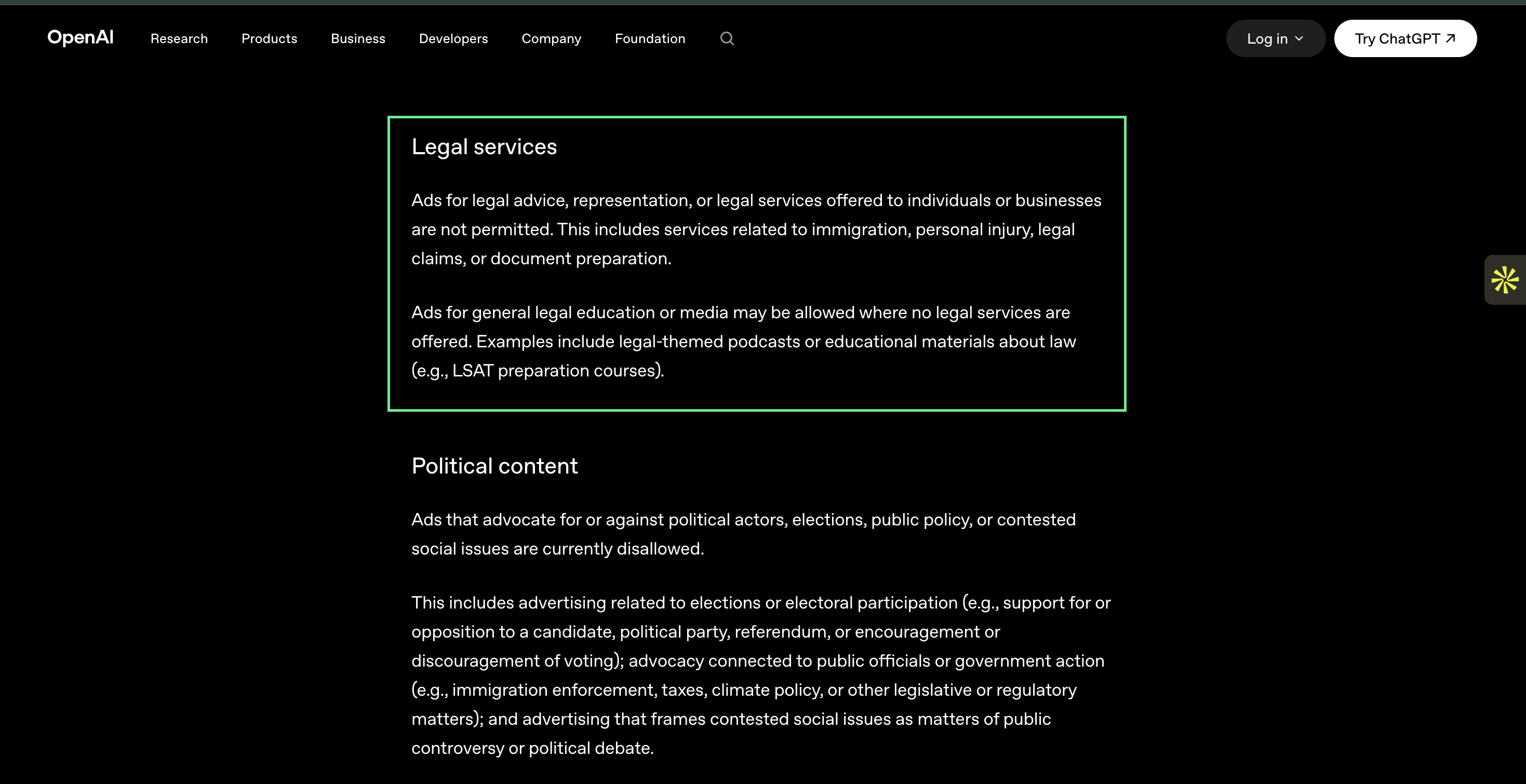
"Ads for legal advice, representation, or legal services offered to individuals or businesses are not permitted. This includes services related to immigration, personal injury, legal claims, or document preparation. Ads for general legal education or media may be allowed where no legal services are offered."
Read that second sentence again. Immigration and personal injury aren't collateral damage from some vague rule. They're the named examples. If you run marketing for a personal injury practice or handle immigration cases, OpenAI wrote the prohibition with you specifically in mind.
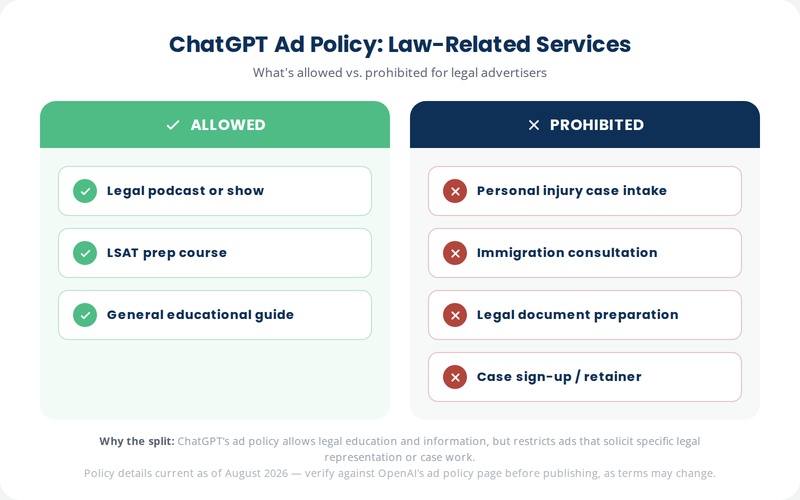
What is allowed sits on the other side of a bright line: education and media where no service is being sold. A legal-themed podcast. An LSAT prep course. A guide that teaches people about the law without offering to represent them. The moment your ad points a prospect toward hiring you, you've crossed from allowed to prohibited.
If the ad ends in "call us for a consultation," it's a legal service. And legal service ads are off the table right now.
One more thing that matters for compliance. OpenAI reviews the whole experience, creative through landing page, and rejects ads whose destination introduces disallowed content. So the clever workaround where you run a "free legal guide" ad that funnels to a case-signup page doesn't survive review. They're looking at where the click lands, not just the headline.
Why the Eligibility Line Is Genuinely Murky
If the policy is that clear, why do I keep calling eligibility murky? Because OpenAI's own document argues with itself, and most people pitching this haven't read closely enough to catch it.
In the ad-content section, OpenAI says it "may approve ads from approved advertisers within the financial services, healthcare & medicine, and legal services categories," reviewed case by case. Read that alone and legal services sounds like a maybe. Then the detailed legal services section says advice, representation, and services are flatly "not permitted." Same document, two different temperatures. One line cracks the door, the next slams it.
Then there's the confusion nobody untangles for you: placement versus advertiser eligibility. In an April update, OpenAI changed its placement rules so ads are no longer categorically blocked from appearing near medical, legal, and financial conversations. That's about whether a travel ad can show up while someone chats about a legal topic. It says nothing about whether a law firm can be the advertiser. Two completely different axes, and I've seen pitches quote the placement change as proof that "lawyers can now run ChatGPT ads." They can't. The loosened rule was never about them.
So when an agency tells you with total confidence which side of the line your campaign falls on, ask how they squared the case-by-case language against the flat prohibition, and whether they're citing advertiser rules or placement rules. Most can't answer, because they never noticed there was a difference.
The Ad-Credits Tell: Why the Hype Won't Slow Down
You'd think a policy that bans legal service ads would quiet the pitches. It won't, and the reason is money.
OpenAI is reportedly preparing promotional ad credits to pull more marketers into testing the ChatGPT ads product. That's a standard land-grab play. Google and Meta both seeded their early ad ecosystems with free credits to build habit and inventory. It works. But it also means the platform itself is incentivized to keep the "get in now" story alive, and OpenAI has been open that it wants to expand access to advertising over time.
Here's the trap for a law firm. Credits lower the cost of testing, so the pitch gets easier to say yes to. "It's basically free to try." Free to try a channel you're not eligible to run on isn't a deal. It's a way to burn your team's time chasing setup, approvals, and rejections while your actual pipeline goes unattended.
The credits are aimed at eligible consumer verticals. The pitches, conveniently, are aimed at whoever will book a call. Those two audiences are not the same, and the gap between them is where firms get sold.
New-Platform Hype Always Outruns the Rulebook
Strip away the specifics and this is an old story. A new platform opens ad inventory. The rulebook for regulated industries lags months behind the marketing push. And a wave of agencies rushes to sell "first-mover advantage" into the gap before anyone confirms the rules.
We lived through it with Facebook, where legal advertisers spent years bumping into restricted-category rules around personal attributes. We lived through it again when Google reshaped Google Ads for lawyers and rolled out Local Services Ads with license verification and screening that caught plenty of firms flat-footed. Every time, the hype cycle and the compliance reality arrive on different calendars.
The firms that got burned had one thing in common. They treated "be first" as the strategy instead of "be right." Being first on a channel you're barred from isn't an advantage. It's motion mistaken for progress.
New-platform hype always outruns the actual rulebook. The firms that win read the rulebook first, then move fast.
None of this means ChatGPT is irrelevant to your growth. It means the ad product isn't the part that's ready for you, and confusing the two is exactly what the urgency pitch is counting on.
What Actually Deserves Your Attention Right Now
Here's the reframe I give every firm owner who forwards me one of these emails. The real opportunity with AI search isn't buying an ad slot inside ChatGPT. It's becoming the answer ChatGPT gives when someone asks it to recommend a lawyer.
That's a discipline, and it's available to you today with zero eligibility gate. Getting cited in AI answers comes from the same foundation that earns you organic rankings: authoritative content, clean structure, strong reviews, and a site the models can actually parse. If you want the playbook, start with how generative engine optimization works for law firms. That's where the AI attention is actually going, and no promo credit expires on it.
While the ChatGPT ad door stays closed to legal services, the channels that already convert are still open and still underused. A tightly managed PPC program built for law firms puts you in front of high-intent searchers today. Google's Local Services Ads and a disciplined organic strategy remain the backbone of predictable case flow. And if you want to understand the full landscape before you spend a dollar, our breakdown of what actually works in lawyer advertising is a better use of the next hour than any countdown-timer webinar.
Curious whether ChatGPT itself is worth using inside your firm, separate from ads? That's a real yes, and we cover it in our guide to using ChatGPT for lawyers. Ads and tooling are two different questions, and the tooling one has a much better answer today.
When you're ready to build a channel you're actually eligible to run, book a call with our team and we'll map the moves that move cases now, not the ones that sound good on a webinar. First mover on the right channel beats first mover on a locked door every time.
Frequently Asked Questions
Can law firms run ads on ChatGPT right now?
Not for legal services. OpenAI's ad policy prohibits ads for legal advice, representation, or legal services, and specifically names immigration, personal injury, legal claims, and document preparation. A firm advertising to sign clients falls squarely inside that prohibition today.
What legal-related ads does OpenAI actually allow on ChatGPT?
Only general legal education or media where no legal service is being offered. Think legal-themed podcasts, educational materials about the law, or an LSAT prep course. The moment an ad promotes hiring a lawyer or buying a legal service, it crosses into the prohibited category.
Why do agencies keep pitching ChatGPT ads for lawyers if they're prohibited?
Because urgency sells. New ad platforms create a first-mover narrative that's easy to market, and OpenAI is reportedly preparing promotional ad credits that make the "try it now" pitch even easier. The incentive to keep the hype alive doesn't depend on whether legal advertisers are eligible.
Will lawyers ever be able to advertise on ChatGPT?
Probably, eventually. OpenAI says restricted categories may expand over time and reviews some categories case by case, and it has signaled it wants to broaden access to advertising. But there's no confirmed timeline or approval path for legal service ads today, so treat any specific promise as speculation.
Does OpenAI's policy change mean lawyers can advertise near legal conversations now?
No, and this is a common misread. OpenAI loosened its placement rules so ads can appear near medical, legal, and financial conversations, but that governs where other advertisers' ads show up. It does not make law firms eligible to be the advertiser. Placement eligibility and advertiser eligibility are two separate things.
What should my firm invest in instead of ChatGPT ads?
Focus on channels you're eligible for and that already convert. Generative engine optimization helps you become the answer ChatGPT recommends, with no ad-eligibility gate. Google PPC and Local Services Ads deliver high-intent leads today, and organic search remains the most durable source of case flow. Those beat a locked ad product every time.
What happens if I try to run a legal service ad on ChatGPT anyway?
It gets rejected. OpenAI reviews the full ad experience, including the creative, the copy, and the landing page, using automated systems with human oversight. An ad that promotes legal services, or a "free guide" ad that funnels to a case sign-up page, fails review because the destination introduces prohibited content. Trying to route around the policy wastes setup time rather than buying you early access.
Is advertising on ChatGPT the same as getting recommended by ChatGPT?
No, and the difference is the whole opportunity. Advertising means paying for a placement, which legal services can't do yet. Getting recommended means your firm shows up when someone asks ChatGPT to suggest a lawyer, which comes from authoritative content, strong reviews, and a well-structured site. The second one is available to you today and doesn't run on ad credits.
Do legal ethics rules also affect ChatGPT advertising for lawyers?
They will once the platform opens to legal services. State bar advertising rules govern how you can market regardless of channel, covering things like misleading claims, disclaimers, and solicitation. For now the constraint is simpler than ethics compliance: OpenAI's own policy bars the ads outright, so bar rules never even come into play.