

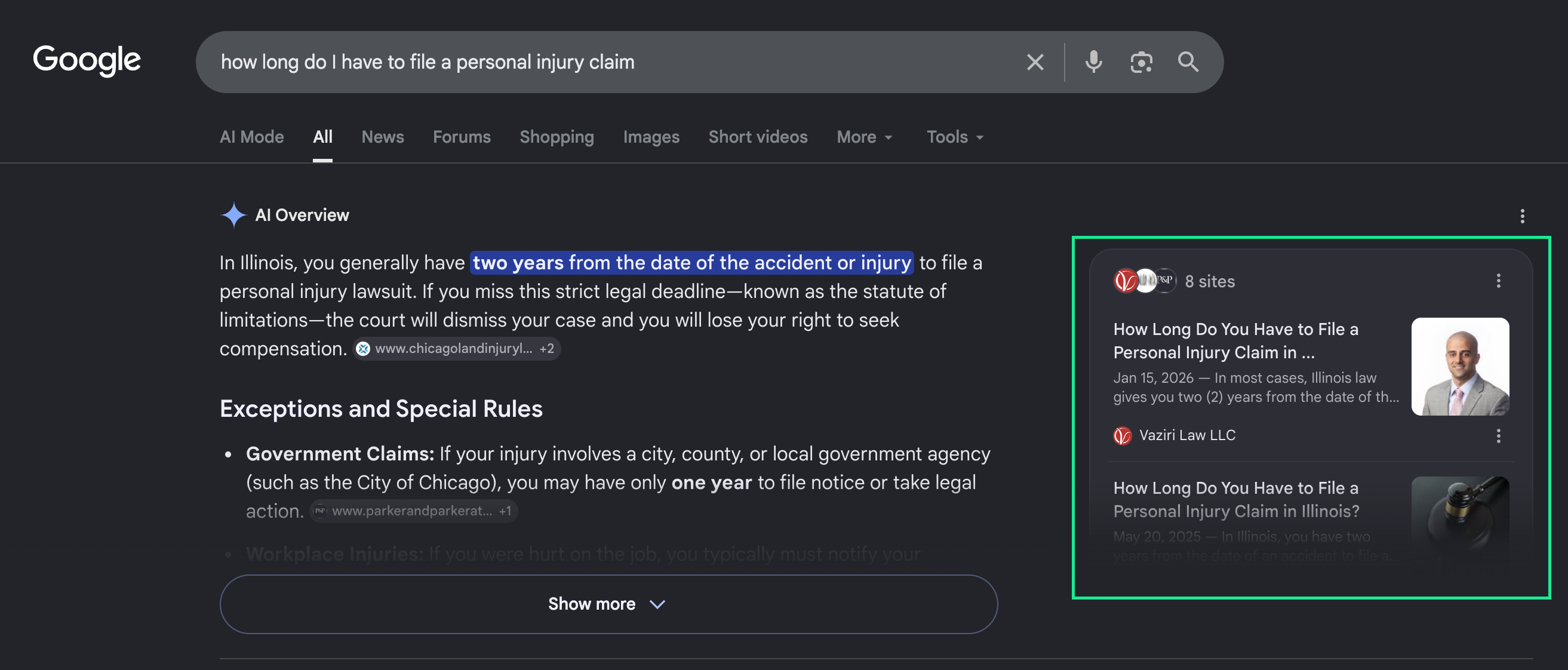
A prospective client types "what should I do after a truck accident in Dallas" into Google. Before they reach the first blue link, a boxed answer appears at the top of the page, written by AI, citing three or four sources. That box is an AI Overview, and for a growing share of legal searches it is the first thing anyone reads.
The firms cited in that box get the attention. Everyone else competes for what's left below it. I've watched this shift move faster in legal than almost any other industry, because the questions people ask before hiring a lawyer are exactly the kind AI loves to answer.
Getting featured is not luck. It follows a pattern you can build toward. Here's the playbook I give law firms who want to show up in that box.
Why AI Overviews Are the New Top of the Page
Google began rolling AI Overviews out to everyone in the US at its I/O event in May 2024. They now sit above the traditional results for a wide range of informational queries, and legal questions are full of them. "How long do I have to file a claim," "is my case worth pursuing," "do I need a lawyer for a DUI" all tend to trigger one.
Here's what matters for your firm. The AI Overview cites its sources with clickable links, and being one of those citations is a direct signal that Google treats your content as trustworthy on that topic. It's the closest thing to an endorsement the search engine offers.
Being cited in an AI Overview tells every future prospect that Google's own systems chose your firm as a reliable answer.
This does not replace ranking. It sits on top of it. The same work that earns you strong organic positions is what makes you eligible for the box, which is why the tactics below start with fundamentals and build from there. If you want the strategic view of how AI is reshaping legal discovery, our guide to Generative Engine Optimization for lawyers covers the wider shift.
Start With an SEO Foundation AI Can Trust
Google has said there is no special markup or setting that makes you appear in AI features. The systems draw on the same index and the same quality signals as regular Search. So if a page can't rank, it won't be pulled into an Overview either.
That makes traditional SEO the entry fee. Three things have to be in place before anything fancy matters:
- Crawlable, fast pages. If Googlebot can't render your content, or the page takes five seconds to load on a phone, you're invisible to the model that builds the Overview.
- Content that already ranks. Pages sitting in the top ten for a query are far more likely to be cited than a page buried on page four.
- Clean site structure. Logical navigation and internal links help Google understand which of your pages answers which question.
Do a plain audit before you chase Overviews. Which of your practice-area and blog pages rank on the first page today? Those are your candidates. If the honest answer is "almost none," fix the foundation first. Our breakdown of law firm SEO walks through the technical and content basics, and if you'd rather hand it off, that's what our law firm SEO services are built for.
Structure Every Page So AI Can Quote It
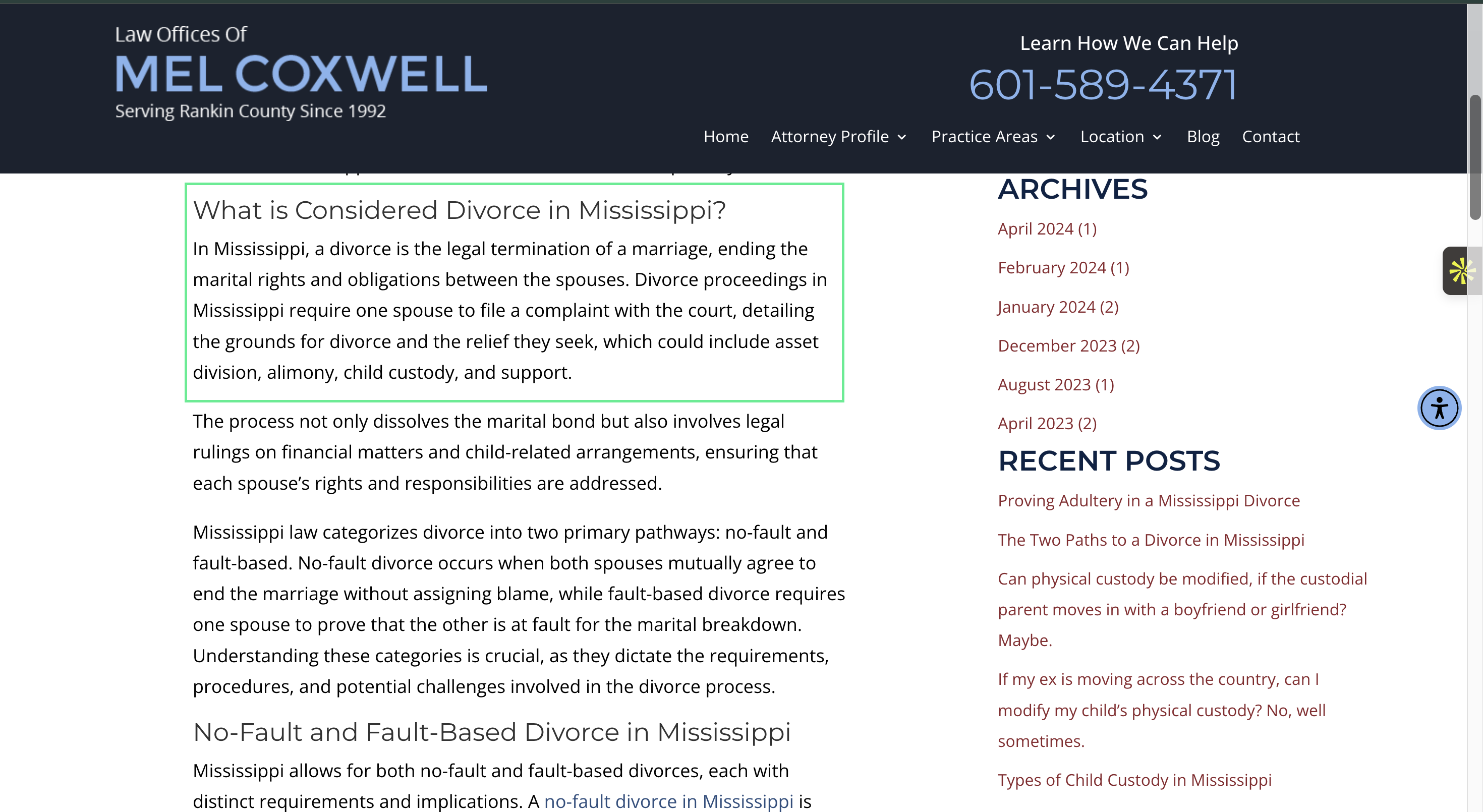
An AI Overview is assembled from small, self-contained chunks of text. Your job is to make those chunks easy to lift. The pages that get quoted answer the question in the first two sentences, then support the answer underneath.
Flip your headings into the exact questions people ask. Instead of "Statute of Limitations," write "How long do I have to file a personal injury claim in Texas?" Then answer it directly in the paragraph below, in plain language, before you add the nuance and citations.
A few structural habits do most of the work:
- Lead with the answer. Put a clear, 40-to-60-word response right under the heading. The model can grab that block whole.
- Keep sentences short. Aim for readable, direct prose. Long, clause-heavy sentences are harder for AI to extract cleanly.
- Break content into scannable pieces. Use descriptive subheads every few hundred words, short paragraphs, and lists where they fit the content.
Write for a real person who is scared and confused, not for a search engine. That instinct produces the direct, useful answers AI systems reward. For the deeper version of this, see how we think about content for a law firm website.
Prove E-E-A-T on Every Page You Publish
Legal content is what Google calls "Your Money or Your Life." Advice that could affect someone's finances, rights, or freedom gets held to a higher standard, and Google's guidance on helpful content leans hard on experience, expertise, authoritativeness, and trust. AI Overviews inherit that bar.
For a law firm, E-E-A-T is not abstract. It shows up in concrete details on the page:
- Real author bylines. Attribute articles to a named attorney, not "admin" or the firm. Include their bar admission, years in practice, and a link to their bio.
- Credentials the reader can verify. State where the lawyer is licensed and what they focus on. Vague authority reads as no authority.
- First-hand framing. Content that reflects actual case experience beats generic explainers. Write what you've seen happen, not what a template says should happen.
I tell firms to treat every substantive page as if a skeptical client will judge the whole practice by it. That's roughly how Google's quality systems treat it too. We go deep on this in our guide to E-E-A-T and YMYL for law firms.
On legal topics, an anonymous page is a disqualified page. Put a credentialed human name on everything you publish.
Add the Schema Markup That Feeds AI
Schema markup is structured data that tells search engines exactly what a piece of content is. It won't force you into an Overview, but it makes your content unmistakable to the systems deciding what to cite. Google's own structured data documentation lays out the supported types.
Four types earn their keep for a law firm:
- FAQPage on any page with a real question-and-answer section. It maps your answers to the questions people search.
- Article on every blog post, carrying the author and publish date that back up your E-E-A-T claims.
- LegalService or Attorney on practice-area and bio pages, so Google understands who you are and what you handle.
- LocalBusiness details, including your reviews as text-based markup, so AI tools can actually read your reputation.
That last point catches a lot of firms. Reviews loaded by JavaScript are often invisible to AI, which means your five-star reputation never enters the picture. Marking them up in plain, structured text fixes it. Our practical walkthrough of schema markup for lawyers shows exactly where each type goes.
Build Topical Authority Around Each Practice Area
AI systems don't cite a single lucky page. They favor sites that clearly own a subject. A firm with one thin article on car accidents loses to a firm with a full library covering the claim process, insurance tactics, settlement ranges, and what to do at the scene.
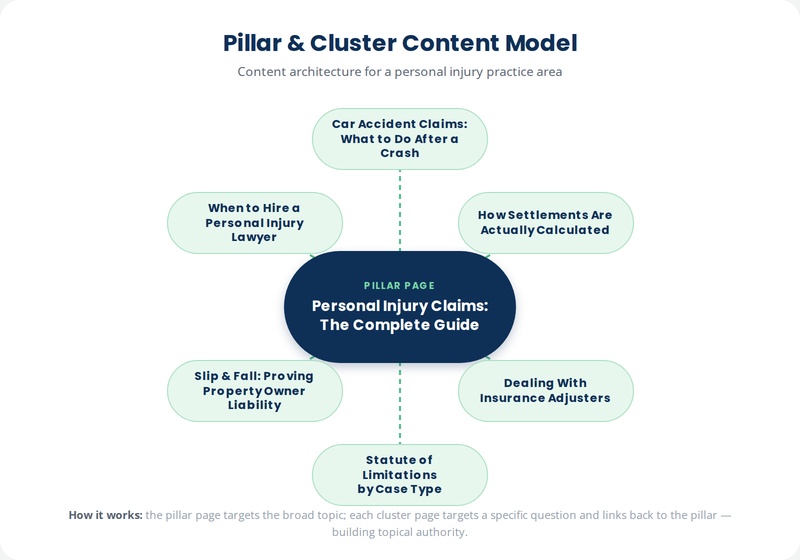
The structure that builds this is the pillar-and-cluster model. Create one deep, authoritative page on a broad topic, then surround it with focused articles on every sub-question, all linked together.
For a personal injury practice, that looks like a pillar page on "car accident claims" supported by clusters such as:
- "What to do in the first 48 hours after a crash"
- "How car accident settlements are calculated"
- "When to reject an insurance company's first offer"
- "How long a car accident lawsuit takes"
Link the clusters up to the pillar and back down again, using anchor text that names the destination. This tells Google your site is a knowledge hub on the subject, and it multiplies the number of specific questions you can be cited for. Our approach to content marketing for law firms is built on exactly this structure, and the same clustering discipline drives local SEO for lawyers.
Earn the Off-Site Signals That Confirm Trust
Everything above happens on your site. The last layer happens off it, and it's what separates a credible source from a confident-sounding one. AI systems weigh how the rest of the web talks about you.
Three off-site signals carry the most weight for law firms:
- Relevant links. A mention from a bar association, a local news outlet, or a respected legal publication counts for far more than a pile of directory listings. Quality and relevance beat volume every time.
- Consistent citations. Your name, address, and phone number should match everywhere they appear. Conflicting listings erode the trust you're trying to build.
- Genuine reviews. A steady flow of detailed client reviews reinforces that real people vouch for you, which is the kind of corroboration AI models look for.
Keep the on-site content fresh while you do this. Add a visible "last updated" date and revisit older pages as laws and figures change. Stale advice on a legal page is a liability, and freshness is a signal Google reads. If you want the practical link-earning tactics, start with our guide to link building for lawyers.
None of this is a one-time project. AI Overviews reward the firm that keeps publishing clear, credible, well-structured answers longer than its competitors are willing to. Start with the practice area that matters most to your bottom line, build the cluster, prove the expertise, and let the citations follow. If you'd like a second set of eyes on where your firm stands, book a call and we'll map it out together.
Frequently Asked Questions
What is a Google AI Overview?
A Google AI Overview is an AI-generated summary that appears at the top of the search results for many questions. It answers the query directly and links to the sources it drew from. For law firms, being one of those cited sources puts your name in front of a prospect before they reach any traditional listing.
Can I pay Google to appear in an AI Overview?
No. AI Overviews are part of organic Search, not an ad placement, so there is no way to buy your way in. You earn a spot by publishing genuinely helpful, well-structured, trustworthy content that already performs in regular search results.
Is there special code or schema that guarantees a spot?
No single markup guarantees inclusion. Google has confirmed it uses the same core Search signals for AI features, so there's no secret setting. That said, schema like FAQPage, Article, and LocalBusiness makes your content easier for the system to read and cite correctly.
Do I need to rank on page one to be featured?
Not strictly, but it helps enormously. Pages already ranking in the top ten for a query are the most common sources for its AI Overview. If a page can't rank at all, treat that as the first problem to solve before chasing the Overview.
How long does it take to start showing up?
There's no fixed timeline. Content built on an existing, well-ranking foundation can be cited within weeks of publishing, while a firm starting from a weak site should expect several months of foundational work first. Consistency matters more than speed.
Why do my Google reviews seem invisible to AI tools?
Reviews that load through JavaScript are often unreadable to AI crawlers, so your reputation never factors into the answer. Adding text-based review or LocalBusiness schema to your site exposes those ratings in a format AI systems can actually parse.
What kind of content gets cited most often for legal queries?
Clear, question-led pages that answer directly and are written by a named, credentialed attorney. Think "how long do I have to file a claim in [state]" answered in the first two sentences, backed by real experience and accurate figures with sources.
Does E-E-A-T really matter more for law firms?
Yes. Legal advice falls under Your Money or Your Life topics, which Google holds to a higher quality bar. Named authors, verifiable credentials, and content grounded in real case experience carry disproportionate weight compared with lower-stakes subjects.
Should I worry that AI Overviews will steal my clicks?
Some purely informational searches will end in the Overview without a click, and that's fine. The high-intent searches that lead to a consultation still send motivated visitors to cited sources. Being the firm named in the answer builds recognition that pays off when someone is ready to hire.
What's the difference between optimizing for AI Overviews and GEO?
AI Overviews are one surface inside Google Search. Generative Engine Optimization is the broader practice of getting cited across all AI answer tools, including ChatGPT and Perplexity. The habits overlap heavily, so work done for one usually helps the other.