

Picking a domain name for your law firm feels like it should be a five-minute decision. It rarely is. Owners agonize over it, and then, once it is picked, they assign it a kind of magic power it does not have.
I have changed my own thinking on this over the years, so I want to give you the honest version. Not the checklist every marketing blog copies from the last one. Where a branded name still wins, where a keyword-rich domain now earns its keep, what the extension actually does (spoiler: less than you think), and how much of this is a trap that costs firms money for nothing.
The domain is not the asset. The content, the links, and the clients you build on top of it are.
Your Domain Name Is Not the Asset You Think You Bought
Here is the belief I have spent years pushing back on. A law firm owner buys a domain, sees it sitting in their registrar account, and assumes it is now working for them. It is not. It is a mailbox with your name on it. Nobody has mailed anything yet.
What ranks, what pulls in calls, what builds a reputation, is everything you attach to that name. The content on the pages. The links pointing at it. Real people visiting, reading, and calling. A domain with none of that is a recurring invoice you pay every year for the privilege of owning a string of text.
That reframe matters because it settles most of the arguments below. Once you accept that the name is a container and not the value, questions like "branded or keyword-rich?" and ".com or .law?" get a lot smaller. You stop looking for a shortcut inside the domain and start doing the work that the domain holds.
Branded vs. Keyword-Rich Domains: What Actually Works Now
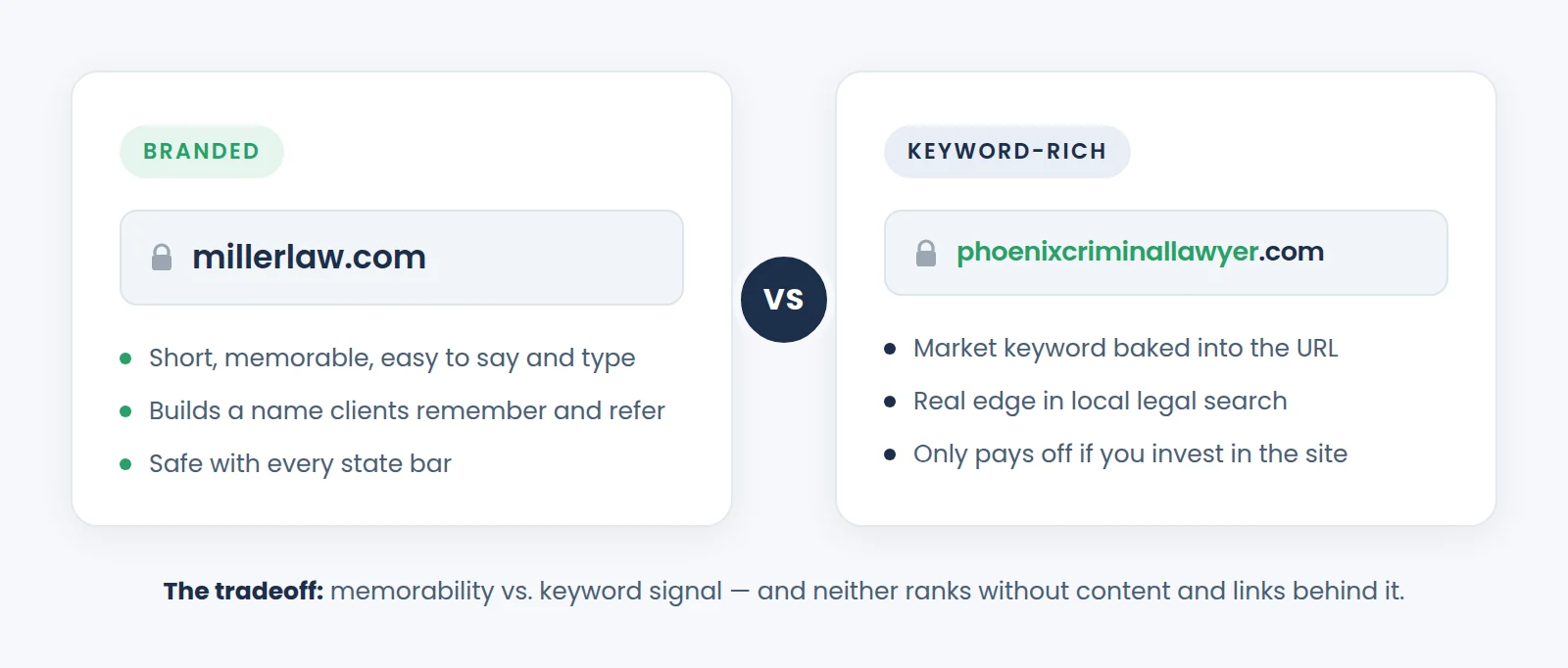
For a long time my advice was simple: use your brand name. Something short, easy to say, easy to type. I did not think a keyword-rich domain drove much real value, and honestly I worried that stuffing your market's top keyword into your URL looked like a hack that Google would slap with an algorithmic penalty.
My view has shifted. A branded domain is still perfectly fine, and for a lot of firms it is the right call. But I have watched keyword-rich domains punch well above their weight for years now, especially in local legal search. You will find sites where the underlying authority is low, the firm is not a household name, and yet the domain is ranking above competitors it has no business beating. Having your market's primary keyword in the domain does seem to hand a firm a disproportionate edge.
Now the caveat, because it is the whole game.
A keyword-rich domain only works if you treat it like a real website. Content, links, traffic, the works. Owning it does nothing.
The way most law firm owners use these domains is the way that fails. They are collectors. They register phoenixpersonalinjurylawyer-dot-com, feel clever, and let it sit. Year after year they pay the renewal, no site ever gets built, and they keep believing the name alone is a hidden advantage waiting to activate. It never activates. I have talked owners out of this more times than I can count, and I have watched the ones who ignored me pay for a stable of dead domains that produced zero clients.
The firms that win with keyword-rich domains are investing in them. Links, content, a real reason for someone to stay on the page. If you are not going to feed a second property, do not buy it. Spreading your effort and budget across multiple half-built sites is one of the most reliable ways I know to get mediocre results everywhere instead of strong results in one place. For most firms, that means putting everything into one domain and building it like it matters, which is the same logic behind every law firm SEO strategy we run.
If you go branded instead, the only real rule is to keep it memorable and short. A clean brand name people can hear once and type correctly beats a long, clever one every time. Pair either approach with a name that reads well, and if you are still settling on the firm name itself, our guide to choosing a strong law firm name covers that decision in depth.
Do Domain Extensions Matter? .com vs. .law, .lawyer, and .attorney
The bottom line up front: the extension does not really matter. There are examples of success and failure with every one of them.
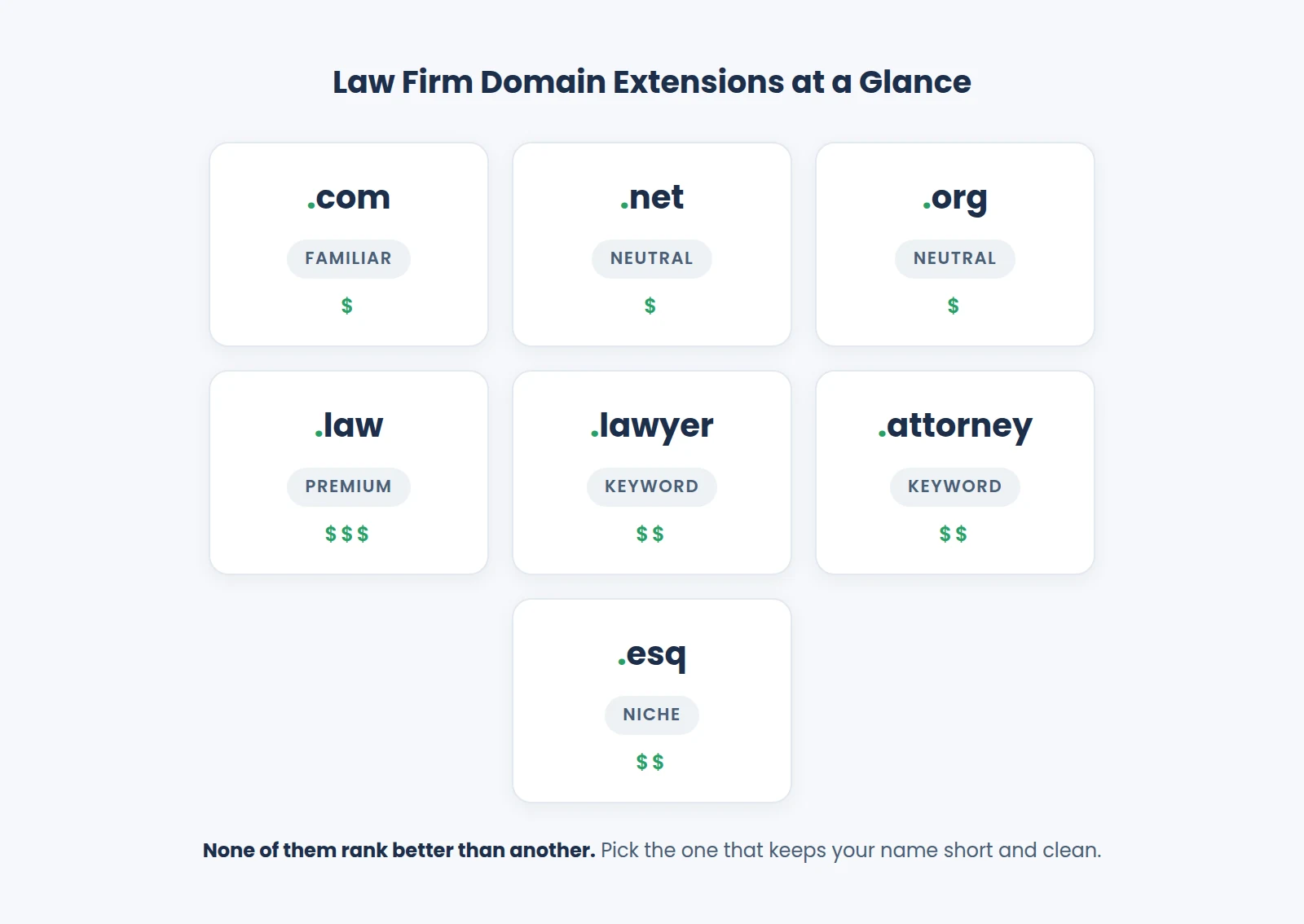
I have never seen a piece of the algorithm that requires a .com or hands preferential treatment to .com over .org or .net. People assume .com carries authority. It carries familiarity, which is a real thing for a client typing your name from memory, but that is not the same as ranking power.
The one extension that genuinely signals authority is .gov, and that is not on the table for you. A .gov site is trusted because it belongs to an actual government entity. The authority comes from what the organization is, not from the letters after the dot. No amount of buying a fancy extension imports that.
So where do the legal-specific extensions fit? There is no inherent value in a .law, .lawyer, or .attorney by itself. Where they get interesting is if you are pursuing a keyword-rich structure. They give you a cleaner, more palatable way to get one of those words into the domain. Instead of criminallawyersphoenix-dot-com, you can run something like phoenix.lawyer or criminal.lawyer. That sends a strong, tidy signal, and some people find it far more elegant than cramming the keyword into a long .com. It is entirely a matter of taste. Google introduced legal and professional extensions like these years ago through its Google Registry launches, and they are widely available now.
My honest guidance stays the same regardless of the extension you land on: simpler is better, and fewer characters is better. Shorter names are more memorable and easier for a client to find. Pick the extension that lets you stay short and clean, then stop thinking about it.
Bar Rules and Misleading Domain Names
Before you fall in love with a keyword-rich domain, do a little homework on your state bar's advertising rules. This is the part firms skip, and it is the part that can actually get you a grievance.
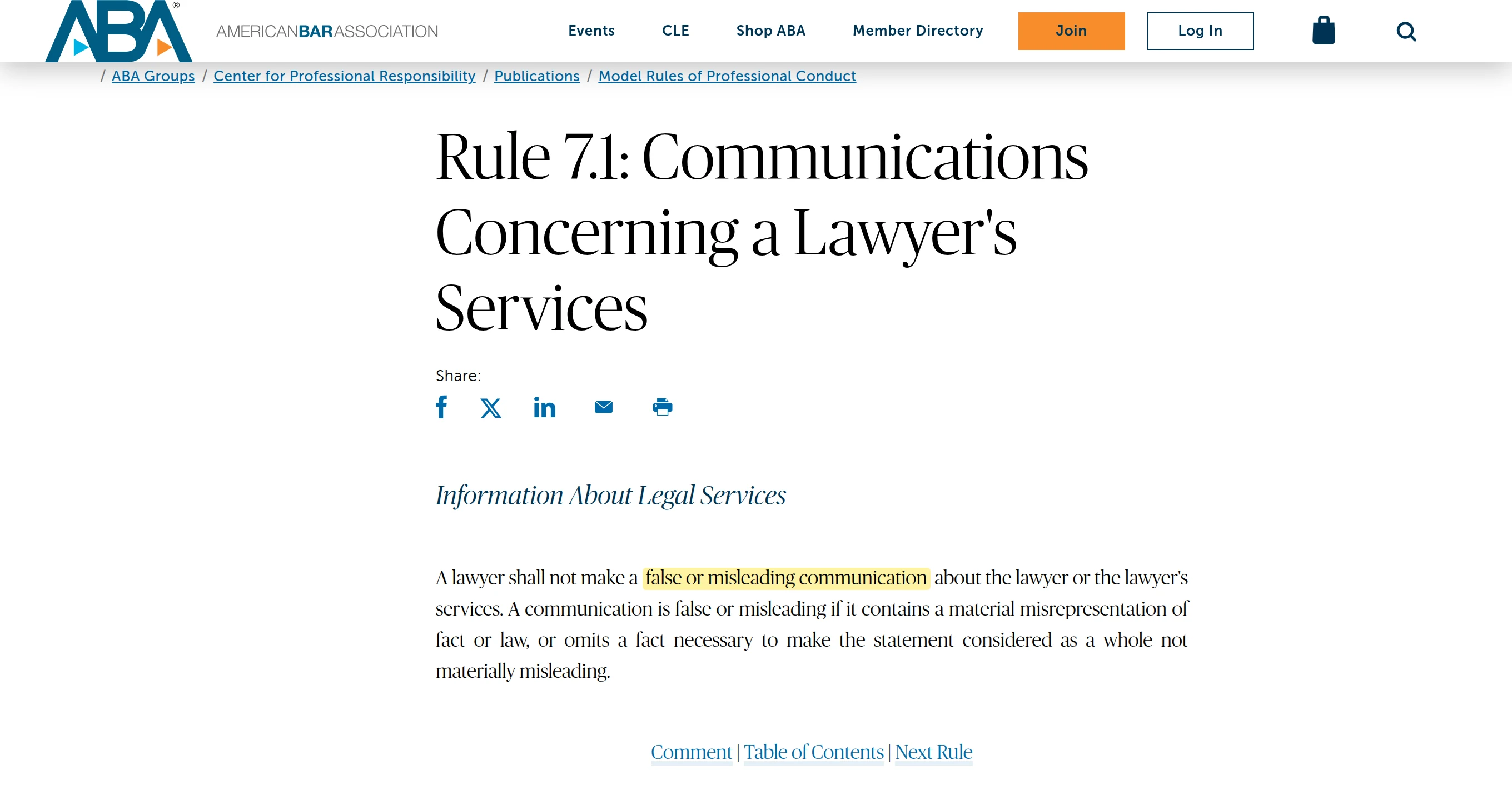
Most states model their advertising rules on ABA Model Rule 7.1, which says a lawyer cannot make a false or misleading communication about their services. A domain name is a communication. Many states also keep a firm-name and trade-name rule in the same chapter, like California's Rules 7.1 and 7.5, which extend the same standard to trade names and professional designations.
In plain terms, a few things tend to draw scrutiny. Superlatives like "best" or "top" and claims like "expert" or "specialist" can imply something you cannot substantiate. A domain that implies a tie to a government agency is a problem. And a geographic or practice-area name that does not match where you are licensed or what you actually do can read as misleading. Rules vary by state, so check your own jurisdiction before you print the URL on anything.
A keyword-rich domain is only an asset if it is a truthful one. "BestDUILawyer" is a fast way to trade a small SEO edge for a bar complaint.
What a Domain Costs and the Truth About Aftermarket Domains
A brand-new domain is cheap. Across the firms we work with, a standard registration runs roughly ten to twenty dollars a year for a .com, and legal-specific extensions like .law usually cost more. That is the whole retail transaction. If a name is available, register it and move on. The land rush ended a long time ago, and there is rarely a reason to panic-buy.
Aftermarket domains are the ones already owned by someone else, sold through a marketplace or a broker, and here the price can jump from twenty dollars to thousands. This is where the real confusion lives, so let me be blunt about it.
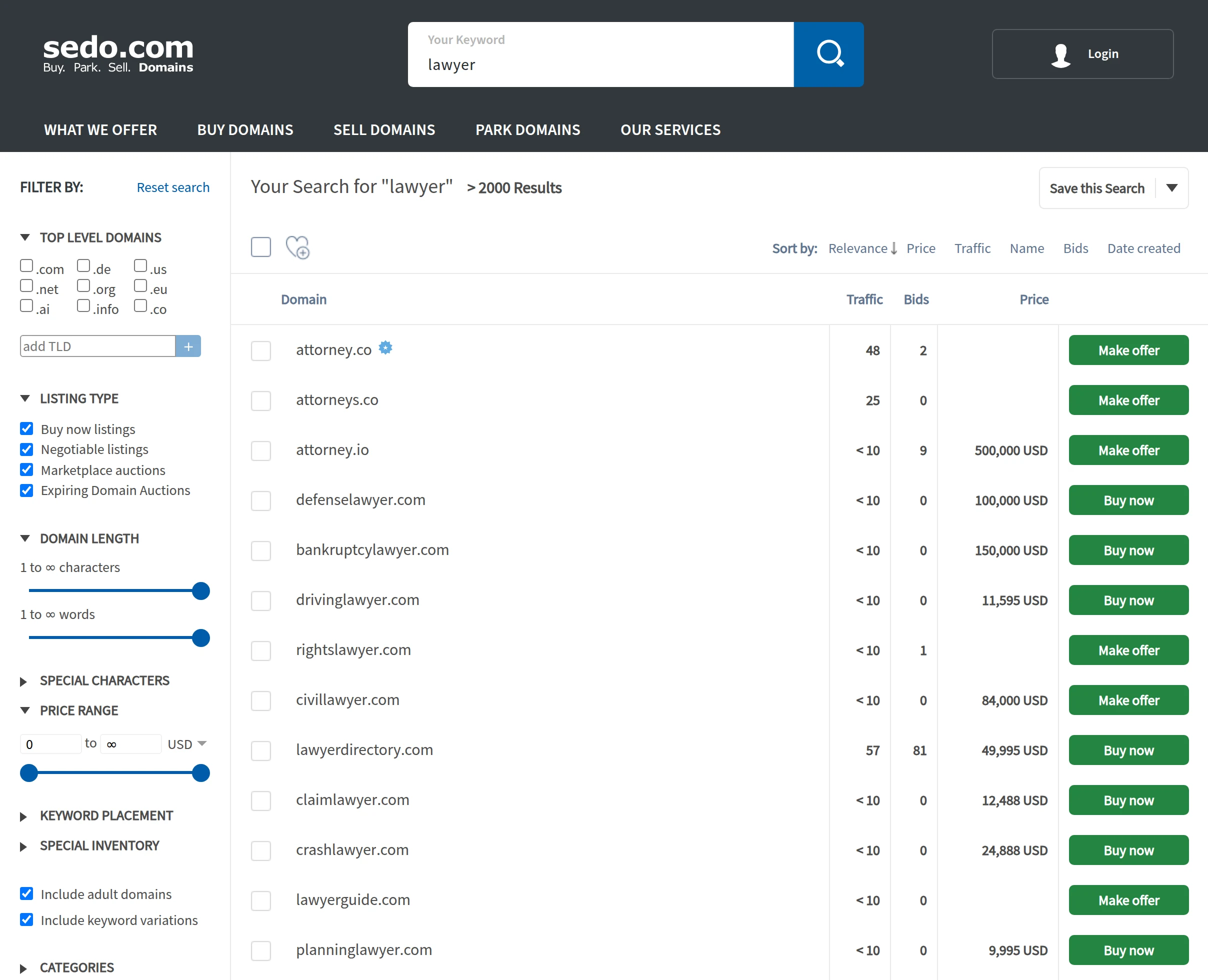
The URL itself is usually not the asset. There are two honest reasons to buy in the aftermarket:
- The domain already carries authority and link value. Someone built a real site on it, earned links, and those links still count. That is worth paying for, because you are buying the accumulated equity, not the letters.
- You assume you are starting from scratch. You buy a keyword-rich name knowing it has no history, and you plan to build everything yourself.
What you should not do is buy an expensive keyword-rich domain and expect it to launch a brand-new website to the moon. There is very little inherent value in the name until you pair it with content, links, and traffic. Without that, an aftermarket domain is the same recurring invoice as a cheap one, just with a bigger number on the receipt. I have watched this exact mistake sink real money, which is the same trap I describe in why an expensive website is not the point.
There is one aftermarket play I do like. If you buy a strong domain and then migrate your existing website onto it, done properly, that can be a genuinely powerful move. You carry your content and history over, redirect carefully, and pick up the benefit of the better name. That is a real strategy. It is a world apart from hoarding domains and hoping. If a migration like that is on your radar, it is worth planning alongside a proper law firm website build rather than bolting it on after.
How to Actually Choose Your Domain
Strip away the noise and the decision is short. Here is what I tell owners.
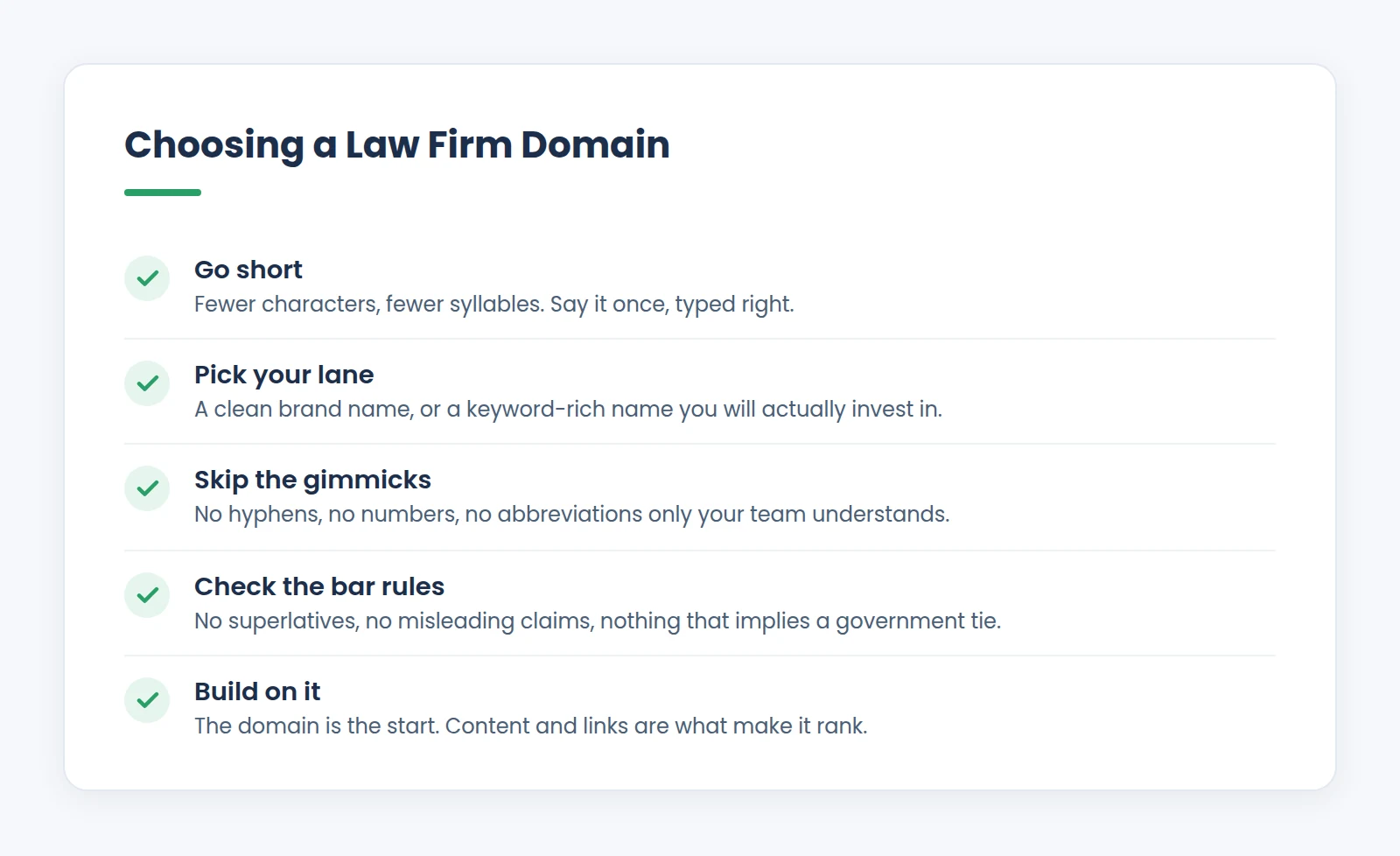
- Go short. Fewer characters, fewer syllables. If you cannot say it once and have someone type it right, it is too long.
- Pick your lane. A clean brand name, or a keyword-rich name you will actually invest in. Not a keyword-rich name you will let sit.
- Skip the gimmicks. No hyphens, no numbers, no cute abbreviations only your team understands. They cost you typos and phone spelling.
- Check the bar rules. No superlatives, no misleading geography or practice claims, nothing that implies a government tie.
- Build on it. Whatever you choose, the domain is the start. The content you put on your law firm website and the links you earn are what make it rank.
If you want a second set of eyes on the name before you commit, or you are weighing a migration to a stronger domain, that is exactly the kind of call we help firms think through. Book a call with our team and we will tell you straight whether the domain you are eyeing is worth building on or worth skipping. And if the branded route is where you land, our law firm branding work and our take on why lawyers over-invest in keyword-rich domains are both good next reads.
Frequently Asked Questions
Should a law firm use a branded domain or a keyword-rich domain?
Both work. A short, memorable branded domain is a safe, strong choice for most firms. A keyword-rich domain can outperform in local legal search, but only if you treat it like a real website and invest in content, links, and traffic. If you will not build on it, go branded.
Does having a keyword in my domain help my law firm rank on Google?
It can give a real edge in local searches, and I have watched low-authority sites punch above their weight because of it. But the domain alone does nothing. The ranking comes from the content and links you attach to it, not the letters in the URL.
Will a keyword-rich domain get my law firm a Google penalty?
Not by itself. A keyword-rich domain paired with a real, well-built site is fine. The risk is thin, spammy sites that exist only to exploit the domain. Build something genuine on it and you are not the target.
Does the domain extension matter for SEO? Is .com better than .net or .org?
No. I have never seen the algorithm favor .com over .net or .org. The .com carries familiarity for clients typing from memory, which has value, but that is not ranking power. Success and failure exist on every extension.
Are .law, .lawyer, and .attorney domains worth it?
There is no inherent value in the extension itself. They shine when you want a clean, keyword-rich structure, like phoenix.lawyer instead of a long .com. It is a matter of taste, not algorithm. Pick whichever keeps the name short.
How much does a law firm domain name cost?
A brand-new .com typically runs about ten to twenty dollars a year to register, with legal-specific extensions like .law costing more. Aftermarket domains already owned by someone else can run from hundreds into the thousands.
Is it worth buying an aftermarket domain for my law firm?
Only for the right reason. It is worth it if the domain already carries real authority and link value you can inherit. It is not worth it if you are paying a premium for a keyword-rich name with no history, expecting it to rank on its own. It will not.
Can I get in trouble with the bar for my domain name?
You can. Most states follow ABA Model Rule 7.1, which bars false or misleading communications, and many keep a trade-name rule alongside it. Superlatives like "best," implied government ties, and misleading geographic or practice claims are the usual triggers. Check your state's rules.
Should I buy multiple domain names for my firm?
Rarely, unless you will actually build on them or use them to protect your brand from typos. Collecting keyword-rich domains and letting them sit is the most common money-waster I see. Each one is a yearly bill producing nothing.
Can I change my law firm's domain name later?
Yes, and migrating your existing site onto a stronger domain can be a powerful move when done carefully with proper redirects. What you want to avoid is changing frequently, which confuses clients and resets momentum. Plan the move once and do it right.