

What Marketing ROI Actually Means for a Law Firm
Ask ten firm owners how their marketing is doing and most will answer with a feeling. It's "going well," or the phone "seems busy," or the new website "looks great." None of that is ROI. Return on investment is a number, and it answers one question: for every dollar you put into marketing, how many dollars in fees came back out?
Here's the uncomfortable part. In a survey of thousands of U.S. firms, roughly a quarter of law firms admitted they don't measure marketing ROI at all, and more than two-thirds of firms with fewer than 50 lawyers had no written marketing plan. That's a lot of money moving without a scoreboard.
ROI is not a vanity exercise. It's the difference between a marketing budget you defend at partner meetings and one you cut the moment cash gets tight. Once you can trace revenue back to the channel that produced it, marketing stops being a cost center and starts looking like what it actually is: the growth engine of the firm.
If you can't name the channel that produced your last five signed cases, you don't have a marketing problem. You have a measurement problem.
One thing to settle early. For a law firm, "return" isn't only revenue. A steady stream of five-star reviews, a referral relationship that pays off in year three, a brand that makes prospects call you first instead of shopping around. Those matter. But they're hard to bank, so we start where the math is clean: signed cases and the fees they generate. Get that right first, then layer the softer returns on top.
The ROI Formula Built for Law Firms
The textbook formula is simple:
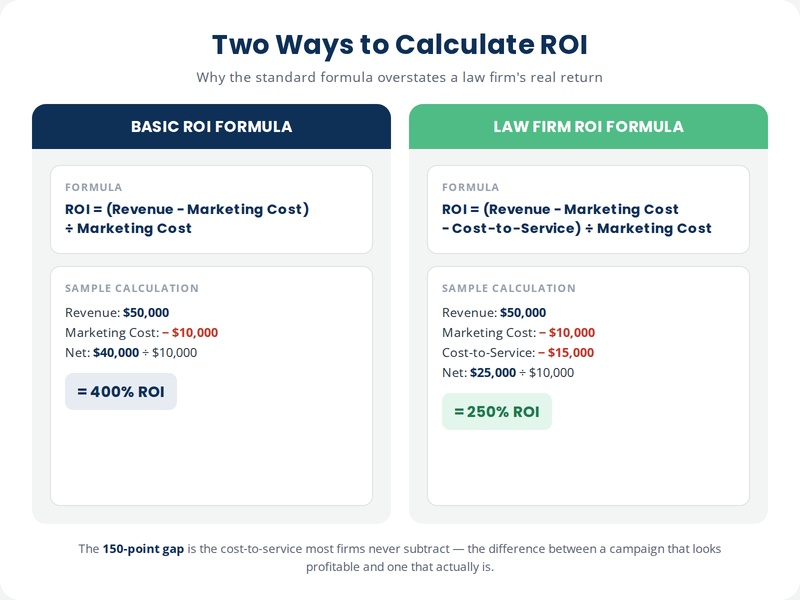
Marketing ROI = (Revenue from Marketing − Marketing Cost) / Marketing Cost
Spend $10,000, generate $30,000 in new client fees, and your ROI is 2x, or 200%. Fine for a lemonade stand. The problem is that a law firm's product costs real money to deliver, and the basic formula pretends it's free.
So use the version that accounts for the work:
ROI = (Revenue from New Cases − Marketing Spend − Cost to Service the Cases) / Marketing Spend × 100
Cost to service is the piece most firms skip. A PPC campaign that floods you with low-value cases can look profitable on paper and lose money once you factor in the paralegal hours, the expert witnesses, and the cases that settle for less than they cost to work up. Revenue that never nets out is not return.
The one number every firm should track: cost per signed case
If ROI feels abstract, start here instead:
Cost Per Signed Case = Marketing Spend / Number of Signed Cases
Say a personal injury firm spends $12,000 a month and signs six cases from marketing. That's $2,000 to acquire each case. If the average case nets $8,000 in fees, the math is obvious and the campaign is a keeper. If it nets $2,500, you're barely clearing the cost to service. Same spend, completely different decision, and you only see it because you know your case value.
This is why I push every firm to calculate its true average case value before touching a marketing dashboard. In practice areas like personal injury, where a single signed case can be worth tens of thousands, you can tolerate a high cost per case. In higher-volume, lower-fee work, your acquisition cost has to be tight or the whole thing underwater. There is no universal "good" number. There's only good relative to what a case is worth to you.
What Counts as a Good Marketing ROI
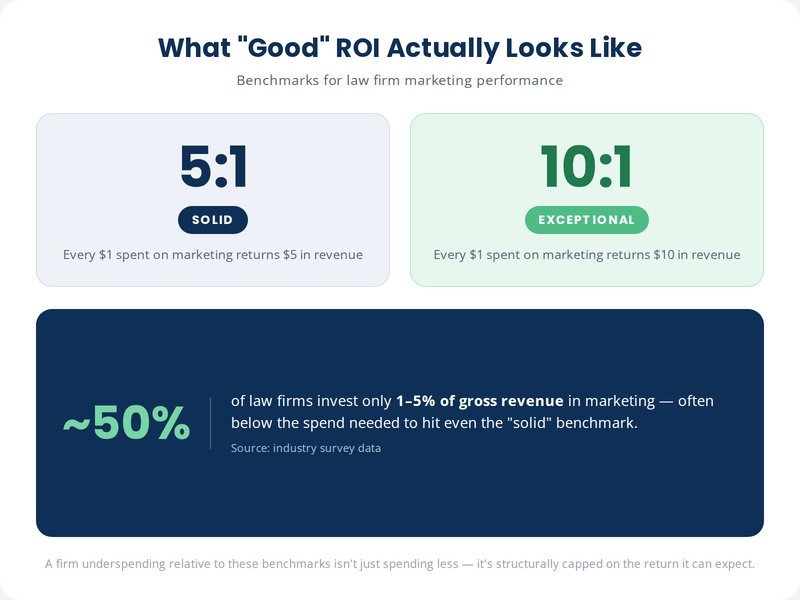
People want a benchmark, so here's the one most marketers use as shorthand. A 5:1 return, five dollars back for every dollar spent, is generally treated as solid. Push to 10:1 and you're in exceptional territory. Below 2:1 and the channel usually isn't carrying its weight once you count the cost to deliver.
Treat those as guardrails, not gospel. A brand-new firm buying its first wave of visibility should expect thinner returns while awareness builds. An established firm with a mature SEO footprint and a warm referral base should be posting numbers that make PPC-only shops jealous. Your benchmark is your own trend line, quarter over quarter, not a stranger's ratio.
Budget sets the frame too. Across that same national survey, about half of firms invested 1% to 5% of gross revenue in marketing, with a smaller group pushing 6% to 10% to grab market share. If you want to pressure-test where your own number should sit, our breakdown of how much a law firm should spend on marketing walks through it by firm stage, and the guide to what legal marketing services actually cost sets realistic price expectations before you judge any return.
A "good" ROI isn't a ratio you read in a blog post. It's your cost per signed case measured against what a case is worth to your firm.
How to Track ROI by Channel
Blended ROI across all your marketing is comfortable and nearly useless. It hides the channel bleeding money behind the one that's printing cases. To fix that, you track at the channel level, and it comes down to four moving parts.
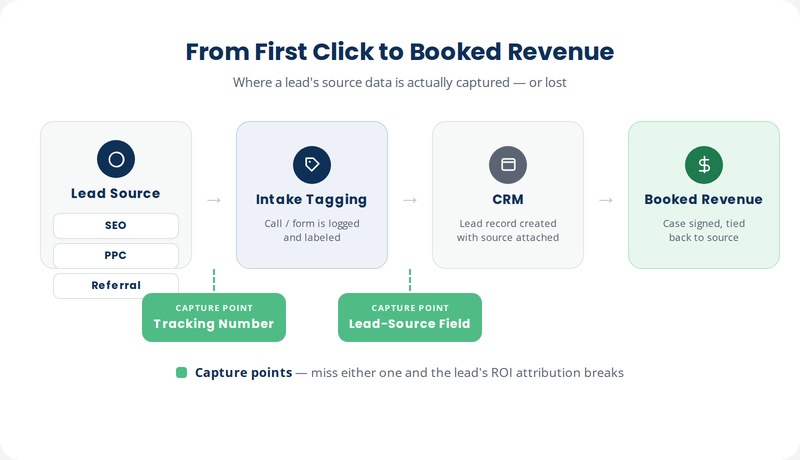
1. Capture the lead source at intake, every single time
This is the whole ballgame, and it's the step firms botch most. When someone calls or fills out a form, your intake person has to record where that person came from before the conversation ends. Google search, a referral, the billboard, an LSA ad. One field, filled in consistently. Skip it and every downstream number is a guess dressed up as data.
2. Put a trackable phone number on each channel
Prospects call. They don't fill out attribution surveys. Dynamic number insertion assigns a unique tracking number to each source, so a call from your Google Ads landing page is tagged differently than one from your Google Business Profile. That's how you separate the channel that rings the phone from the one that just looks busy. Our guide to call tracking for law firms covers the setup end to end.
3. Tie the source to revenue in your CRM
Leads aren't the finish line. Signed cases and collected fees are. Your intake or case management system should carry the lead source all the way through to the revenue that case eventually books. When you can pull a report that says "organic search produced 14 signed cases worth $190,000 last quarter," you're measuring ROI. Anything short of that is measuring activity.
4. Respect the legal sales cycle
Legal buying takes time. Roughly 49% of businesses say organic search delivers their best marketing ROI, yet organic is exactly the channel firms kill too early because it doesn't sign a case in week two. A business client might read your blog for three weeks before calling. A slip-and-fall lead might sit for months. Measure ROI over a rolling 6 to 12 month window, not a 30-day snapshot, or you'll axe the channels that pay you back the most. This is the heart of why attribution is essential for any firm that wants to scale.
The Channels With the Best ROI for Law Firms
Every channel can work and every channel can waste money. What follows is where I've seen the returns actually land for law firms, with the honest tradeoffs.
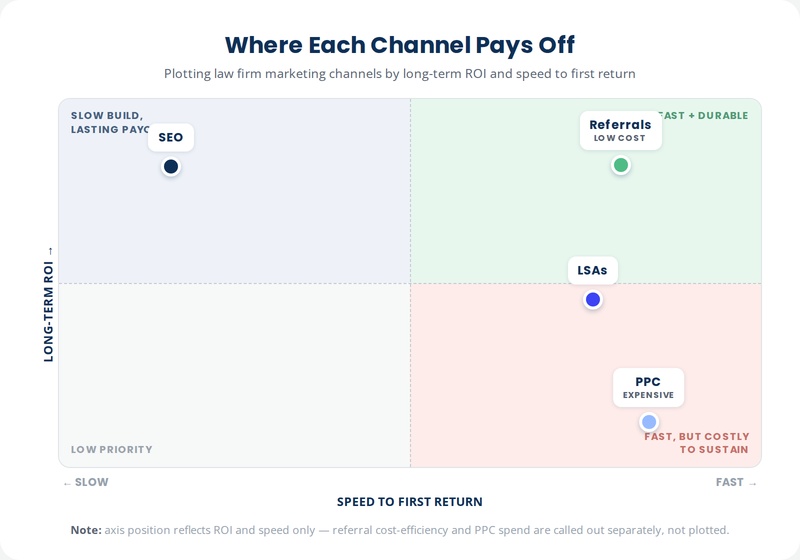
SEO and content. The best long-term ROI in legal marketing, and it isn't close. It compounds, the traffic is free once you've earned the ranking, and the intent is high. The catch is patience. It takes months to build, so it's the worst channel for a firm that needs cases this week and the best one for a firm that wants a durable pipeline. If you're weighing it, our overview of law firm SEO services built to drive revenue lays out what a real program looks like.
Google Local Services Ads and PPC. Speed. You can be in front of high-intent searchers this afternoon. LSAs are pay-per-lead and come with a Google Screened badge, which converts well for local practices. Straight PPC gets expensive fast in competitive markets, so it lives or dies on your landing page and your intake. Great for filling gaps while SEO matures. Dangerous as your only plan.
Referrals and reputation. Word of mouth is still the highest-trust source of new business for most firms, and it's nearly free. The mistake is treating it as luck. Referrals respond to systems: a follow-up habit, a review-generation process, relationships you actually maintain. Cheap to run, hard to scale on command.
Email and reviews. Underused and cheap. A tight email list keeps you top of mind with past clients and referral sources, and a steady flow of recent reviews lifts both your map rankings and your conversion rate. Neither wins the case on its own. Both quietly raise the ROI of everything else you do.
Notice a pattern. The highest-ROI channels tend to be the ones that build an asset you own, an audience, a reputation, a library of ranking pages, rather than renting attention by the click. The bigger playbook lives in our complete guide to law firm marketing strategies that work, and it applies whether you run a family law practice or a plaintiff shop.
The ROI Killers That Quietly Drain Your Budget
Most firms don't have a spending problem. They have a leak problem. Here's where the return quietly disappears.
Worshipping vanity metrics. Impressions, clicks, and "we rank #3" reports feel like progress. They aren't revenue. A number one ranking for a term that never converts is a trophy, not a result. If a report doesn't connect back to signed cases, it's decoration.
The intake leak. This is the biggest one, and it has nothing to do with your ad spend. You can run a flawless campaign, generate a flood of qualified leads, and still lose because calls go to voicemail or forms sit unanswered for six hours. When intake drops the ball, marketing ROI craters and the marketing usually gets blamed. Fix intake and every channel's return goes up at once.
Black-box agency reporting. If an agency can't show you a clear path from spend to signed cases, be skeptical. Some take credit for leads that came from your own brand name or a past referral. Ranking screenshots with no revenue attached are a tell. You're allowed to demand the number that matters.
Killing channels on a 30-day clock. Cutting SEO or content because it didn't produce cases in a month is the most expensive mistake I see. You're pulling out right before the compounding starts, then repeating the cycle with the next shiny tactic. Give durable channels a fair window before you judge them.
Clean up those four and your ROI improves without spending an extra dollar. That's the cheapest growth available to most firms, and almost nobody takes it. If you want a second set of eyes on where your marketing dollars are actually going, book a call with our team and we'll map your spend to real case outcomes.
Frequently Asked Questions
How do you calculate marketing ROI for a law firm?
Use this formula: ROI = (revenue from new cases − marketing spend − cost to service those cases) / marketing spend × 100. Subtracting the cost to deliver the work is what makes it accurate for a law firm, since a case that costs more to work up than it pays isn't a real return. For a faster gut check, divide your marketing spend by the number of signed cases to get your cost per signed case.
What is a good marketing ROI for a law firm?
A 5:1 return is widely treated as solid and 10:1 as exceptional, while anything under 2:1 usually isn't pulling its weight once you count the cost to service the work. But the honest answer is that a good ROI depends on your average case value. A high cost per case is fine when a signed case is worth $20,000, and unacceptable when it's worth $2,000. Judge each channel against what a case is worth to your firm.
Why can't most law firms measure their marketing ROI?
The usual culprit is intake. If no one records where each lead came from at the moment of contact, there's no way to connect revenue back to a channel later. The fix is a single, consistently completed lead-source field at intake, backed by call tracking numbers and a CRM that carries the source through to booked fees.
What marketing channel has the highest ROI for law firms?
SEO and content marketing deliver the strongest long-term ROI because the traffic is free once you rank and it compounds over time. Referrals are the highest-trust and lowest-cost source when you run them as a system. Google Local Services Ads and PPC offer the fastest returns but cost more per case, which makes them best for filling gaps while organic channels mature.
How long does it take to see ROI from law firm marketing?
It depends on the channel. Paid ads can produce leads within days, while SEO and content typically take three to six months to gain traction and six to twelve months to hit full stride. Because legal buying cycles run long, measure ROI over a rolling 6 to 12 month window rather than a single month, or you risk cutting channels right before they pay off.
What is cost per signed case and why does it matter?
Cost per signed case is your marketing spend divided by the number of cases that spend produced. It matters because it translates marketing into the language a firm owner actually thinks in. When you know it costs $2,000 to sign a case worth $8,000 in fees, the decision to keep investing is obvious. It also lets you compare wildly different channels on equal footing.
Should a law firm count reviews and referrals as marketing ROI?
Yes, but track them separately from direct revenue. Reviews, referral relationships, and brand recognition are real returns that compound over years, yet they're hard to bank in a given month. Start with the clean math of signed cases and collected fees, then layer these longer-term returns on top so you don't undervalue the channels that build them.
How much should a law firm spend on marketing?
Most firms invest between 1% and 10% of gross revenue, with about half landing in the 1% to 5% range and growth-focused firms pushing higher to capture market share. New firms building awareness generally need to spend on the higher end. The right number depends on your growth goals, your market's competitiveness, and how efficiently your current channels convert.
Why do vanity metrics hurt marketing ROI?
Impressions, clicks, and keyword rankings feel like progress but don't prove revenue. Firms that optimize for them end up funding activity instead of outcomes, and agencies that report them can hide poor performance behind a busy-looking dashboard. The only metrics that reflect true ROI are signed cases and the fees they generate, traced back to a specific channel.
How does client intake affect marketing ROI?
Intake can make or break your return no matter how good the marketing is. A campaign that generates plenty of qualified leads still loses money if calls go to voicemail or forms sit unanswered. Because intake sits between spend and revenue, tightening it, faster response times, consistent follow-up, and disciplined source tracking, often lifts ROI more than any change to the ad budget.