

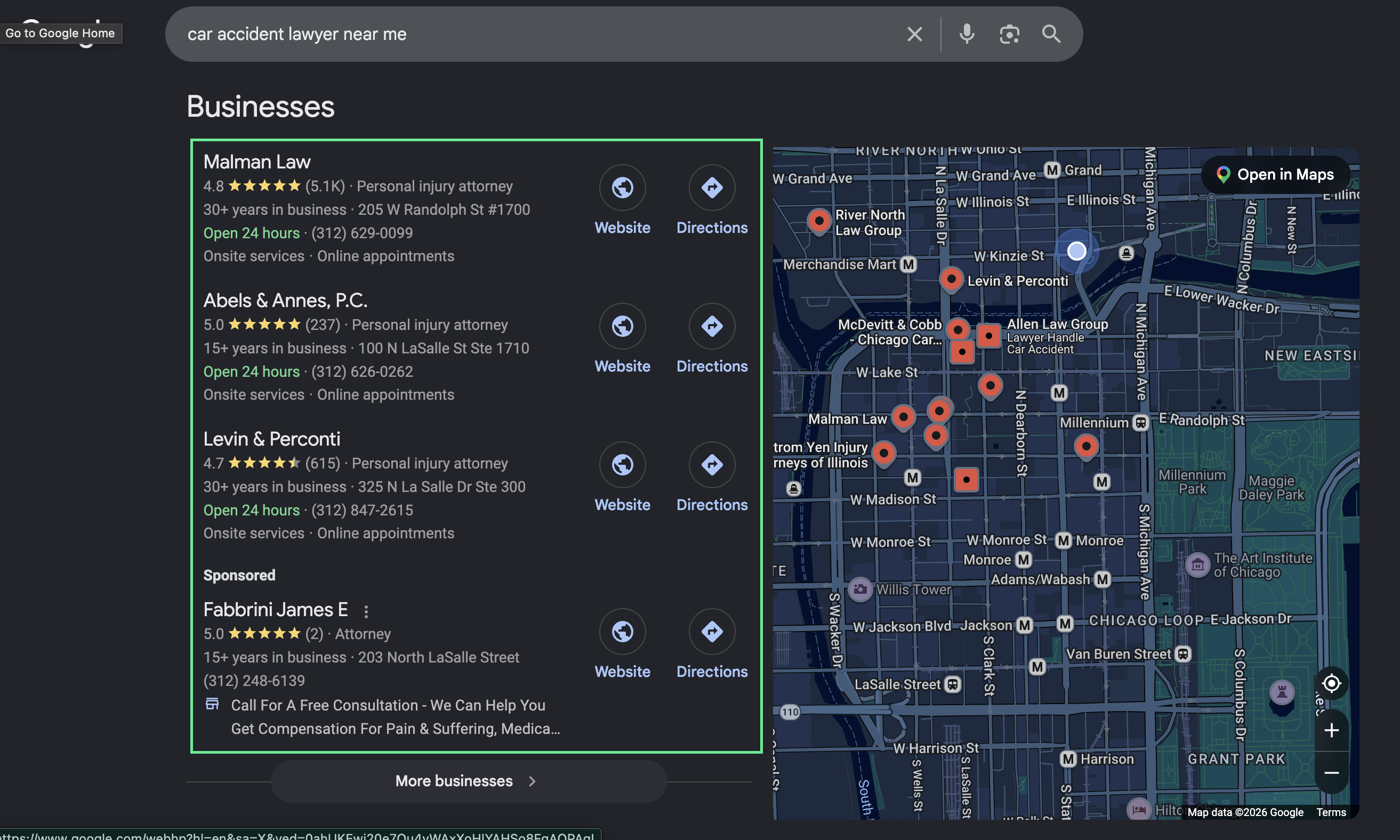
Someone in a fender-bender an hour ago is not reading a 3,000-word essay on search theory. They're on their phone, in pain, typing "car accident lawyer near me," and they're going to call one of the three firms in the map pack before their coffee gets cold.
That's the whole game for personal injury. Local SEO is how you become one of those three. This is the playbook we use to get PI firms there, and where I'd tell you to spend your effort if you only had a few hours a week.
One note up front. This is the local side of the story on purpose. The full picture of ranking a PI website organically (technical SEO, backlinks, statewide content) is its own beast, and we cover it in our guide to marketing for personal injury law firms. Here we're talking about winning the searches that happen within a few miles of your office.
Is Local SEO Actually Worth It for a PI Firm?
Yes, and it's usually the highest-return channel a PI firm has. I'll defend that instead of just asserting it.
Personal injury is a local business dressed up as a legal one. Your client pool is people who got hurt inside your service area, and almost all of them start on Google. The map pack sits above every organic result on mobile, which is where most "near me" injury searches happen. Rank in it and you're the default choice at the exact moment someone decides to call.
The honest counterpoint: local SEO is slow and it's brutally competitive in PI. In a metro like Houston or Atlanta you're up against firms with seven-figure ad budgets who figured this out years ago. If you need cases this week, that's what pay-per-click and Local Services Ads are for. Local SEO is the compounding asset you build alongside them, so that a year from now you're not renting every single lead.
The economics are what make the case. A signed PI case is worth thousands to tens of thousands in fee. When map-pack visibility is producing a steady flow of calls, the cost per signed case from local SEO drops well below what you'd pay for the same case through ads.
For one of our PI firms, local SEO produced signed cases at roughly $4,700 each over the past 12 months. The same firm paid about $6,300 per signed case through paid search. That's around 25% cheaper per case, and the gap keeps widening as the local footprint compounds.
If you can only fund one channel, fund the one that keeps paying after you stop. That's local SEO.
How Google Decides Which PI Firms Show Up Locally
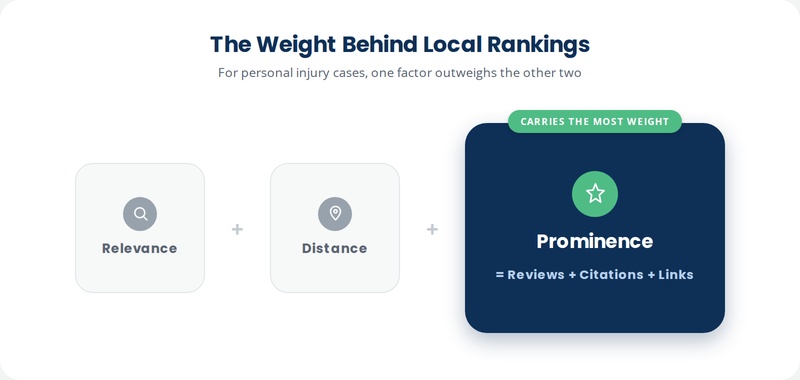
Google is public about this. It ranks local results on three things: relevance, distance, and prominence. What most PI firms miss is how differently those levers behave in a category this competitive.
Relevance is how well your profile and site match the search. For PI that means your Google Business Profile primary category is "Personal injury attorney," not the generic "Attorney." Get this wrong and you're invisible for the searches that matter, no matter how good everything else is.
Distance is proximity between the searcher and your office. You can't move your building, but you can influence which searches you show for by having a real, verifiable address in the markets you want. This is why the virtual-office shortcut backfires, and why multi-office firms need a genuine footprint in each city.
Prominence is where PI is won or lost. It's Google's read on how established and trusted you are, and reviews carry enormous weight here. Two firms can be equally relevant and equally close, and the one with 240 reviews at 4.9 stars will beat the one with 30 nearly every time.
One distinction people blur: the map pack and the organic blue links below it are two different contests with different rules. The map pack rewards your Google Business Profile, reviews, and proximity. Organic rewards your website's content and links. You want both, but for "injury lawyer near me" the map pack is the one that pays first, so that's where a PI firm should start.
Turn Your Google Business Profile Into an Intake Engine
Your Google Business Profile is the single most important asset in local SEO, and most PI firms treat it like a phone-book listing. It's the storefront that decides whether a hurt person calls you or the firm below you. Here's what actually moves the needle.
Category. Set the primary to "Personal injury attorney." Add secondaries only for services you genuinely run (car accident, workers' compensation) and don't pad the list. Extra unrelated categories dilute relevance instead of adding it.
Hours. If you have a 24/7 answering service, set your hours to 24/7. Injury searches spike at night and on weekends, right after the crash. A profile that reads "closed" at 9pm loses the caller who is scared and ready to hire right then.
Photos. Real ones. The building, the actual attorneys, the team, any awards on the wall. Stock imagery reads as fake to both Google and the client comparing you against the firm next to you. This is the trust decision that happens before anyone clicks your website.
The name field. Use your real business name. Stuffing "Best Injury Lawyers" into it can help for a while, and then it gets your listing suspended, which is a catastrophe you feel for months. If you want an injury keyword associated with your brand, register a proper DBA and use it consistently on your site and signage instead of gaming the field.
One caution on call tracking. A call-tracking number is fine and useful, but it has to be implemented so your real business number still shows as the primary. Done sloppily, a mismatched number across your listings undercuts the NAP consistency that local ranking depends on.
One of our PI clients pulls more than 200 calls a month from a single optimized Google Business Profile.
If your profile is already a mess (duplicate listings, a suspension, wrong address history), that's a specific repair job, not a reason to give up. We walk through the worst cases in our guide to fixing Google Business Profile problems.
Reviews: The PI Signal That Compounds
If I could only fix one thing for a PI firm's local visibility, it would be reviews. They drive prominence, and they're the tiebreaker a hurt person uses when two firms sit side by side in the pack.
Three things matter, in this order. Volume, because a firm with 200 reviews reads as the established choice. Velocity, because a steady drip of fresh reviews signals an active, real practice, and a wall of reviews that all landed 18 months ago looks stale. And rating, where the sweet spot is 4.7 to 4.9. A perfect 5.0 across hundreds of reviews actually reads as suspicious to savvy clients.
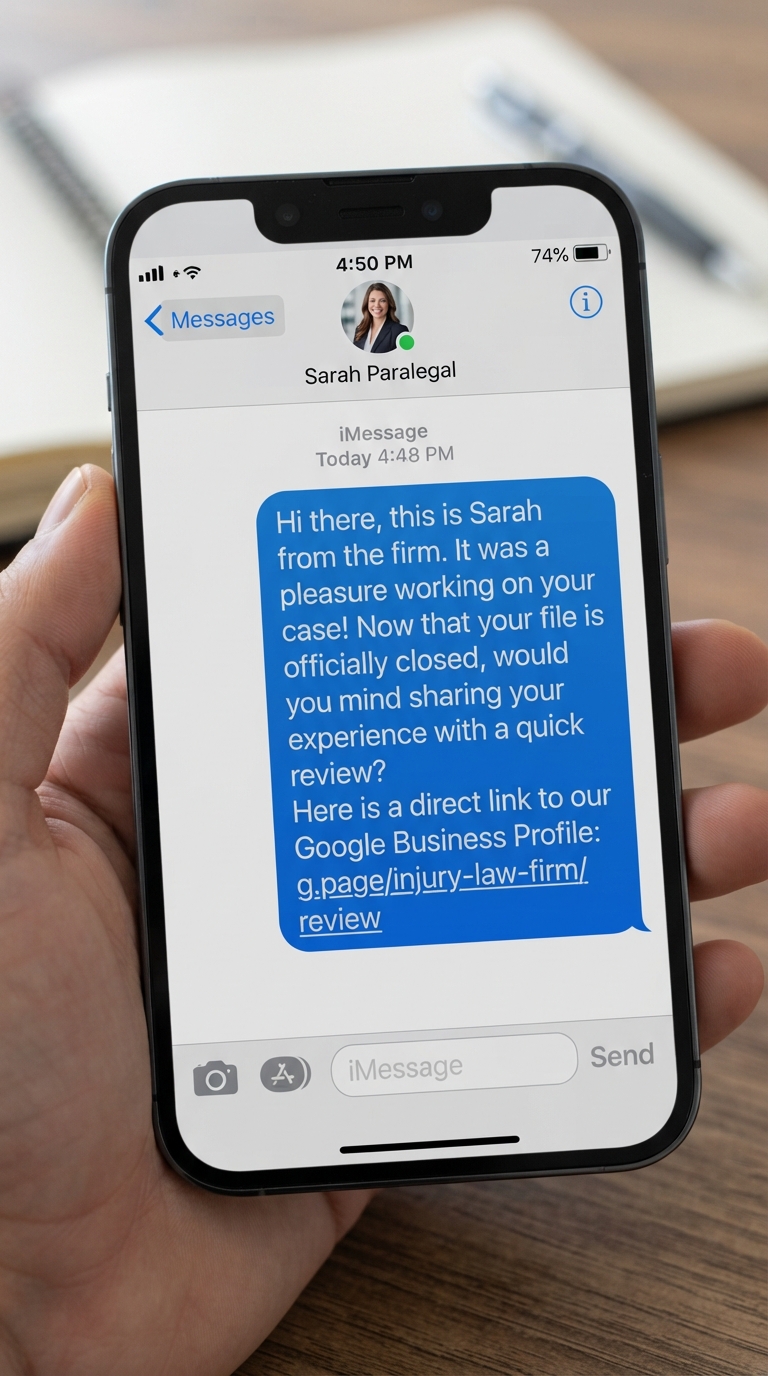
The mistake I see constantly: firms ask for reviews once, at case resolution, months after the client's most grateful moment has passed. Build a system instead. The paralegal who closes the file sends the request the same day, with a direct link to your Google profile so the client taps twice and they're done. Ask every satisfied client, every time.
Respond to every review, the angry ones especially. A calm, professional reply to a one-star rant (without confirming anyone was a client, which would breach confidentiality) tells the next reader you're a firm that shows up when things get hard. That's the exact quality a PI client is shopping for.
City and Practice-Area Pages That Actually Rank
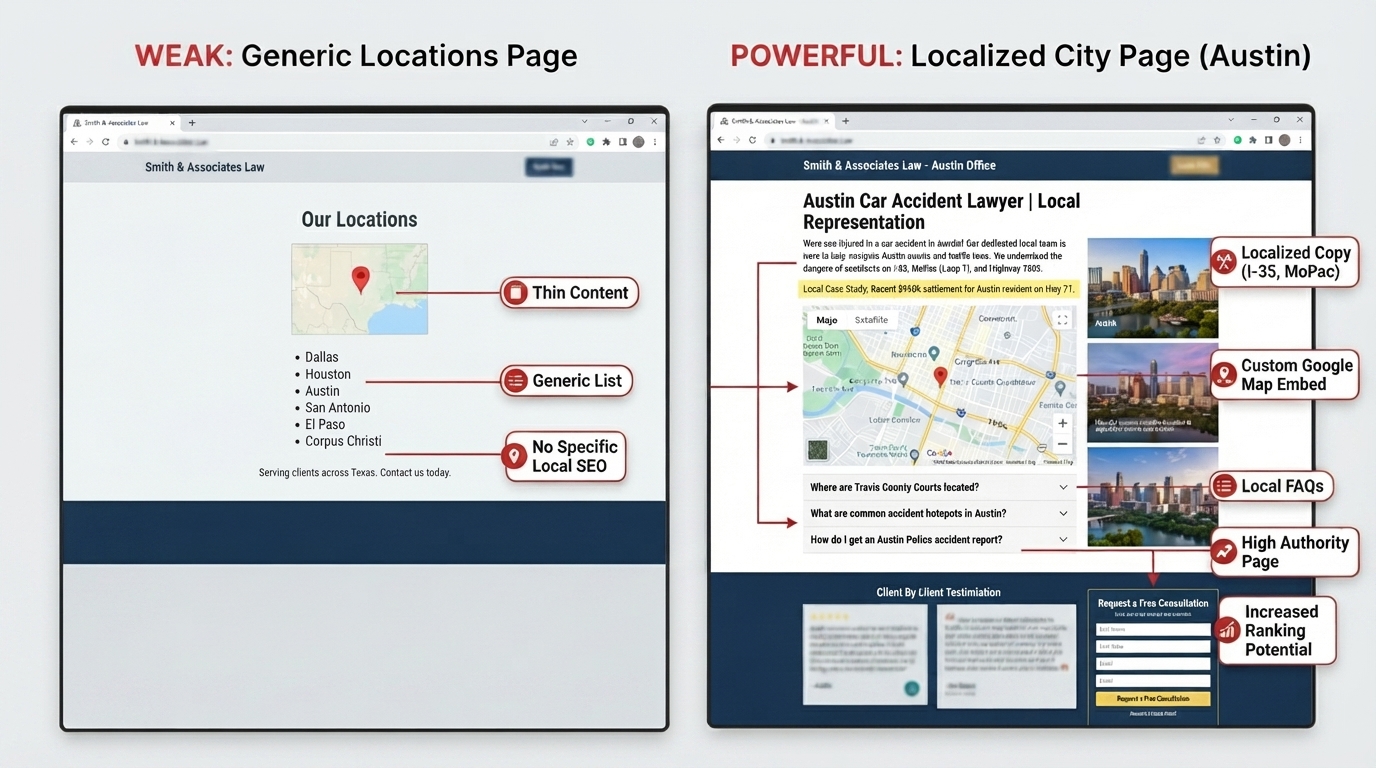
The most common local SEO mistake in PI is one thin "Locations" page listing ten cities. Google treats that as what it is, a list, and it ranks for nothing. If you want to show up in a city, you need a real page built for that city and that case type.
A page that ranks has a clear H1 matching how people actually search ("Austin Car Accident Lawyer"), genuinely local detail, and unique content. Not the same 600 words with the city name swapped. Write about the specific interstates and intersections where wrecks happen in that market, the local courthouse, the way claims tend to play out with the insurers active there. That specificity is exactly what a national competitor copying templates can't fake.
Underneath the pages sits your citation and NAP foundation. Your name, address, and phone need to match, character for character, across Google, Avvo, Justia, Yelp, and the legal directories. Inconsistent citations confuse Google about which data to trust and quietly cap your rankings. This is unglamorous cleanup work, and it's often the difference between position four and position two.
If you run more than one office, resist the urge to fake locations you don't staff. Each real office earns its own profile, its own page, and its own citations. We break down the coordination in multi-location marketing for law firms. For the broader mechanics that apply to any practice area, our local SEO guide for lawyers and the tactics in local SEO strategies for 2026 both go deeper on the fundamentals.
One Atlanta personal injury client came to us with an underperforming site: a mobile PageSpeed score of 30, a structure that fought Google's crawler instead of helping it, and organic visibility that trailed the market's dominant firms. We rebuilt the site on a clean, crawlable architecture, put mobile performance first, and layered in a targeted local SEO program. That meant a library of city- and practice-specific landing pages built around Atlanta search intent, paired with an active Google Business Profile and a real review engine.
The technical rebuild alone lifted mobile PageSpeed by 200%, from 30 to 89, and cut mobile load time by 11 seconds. On the SEO side, organic leads climbed from 6 a month when tracking began to over 200 within two months, then settled into a steady 100-plus a month through early the following year. Their Google Business Profile now holds a 4.9-star rating across 847 reviews.
How to Know Your Local SEO Is Working
Rankings feel good. Signed cases pay the bills. Measure the second one, and use the first only as a leading indicator.
Start inside your Google Business Profile. The Insights (now called performance) tab shows the search terms that surfaced you, how many people called directly from the listing, and how many asked for directions. Direct calls are the number closest to money, so track it month over month.
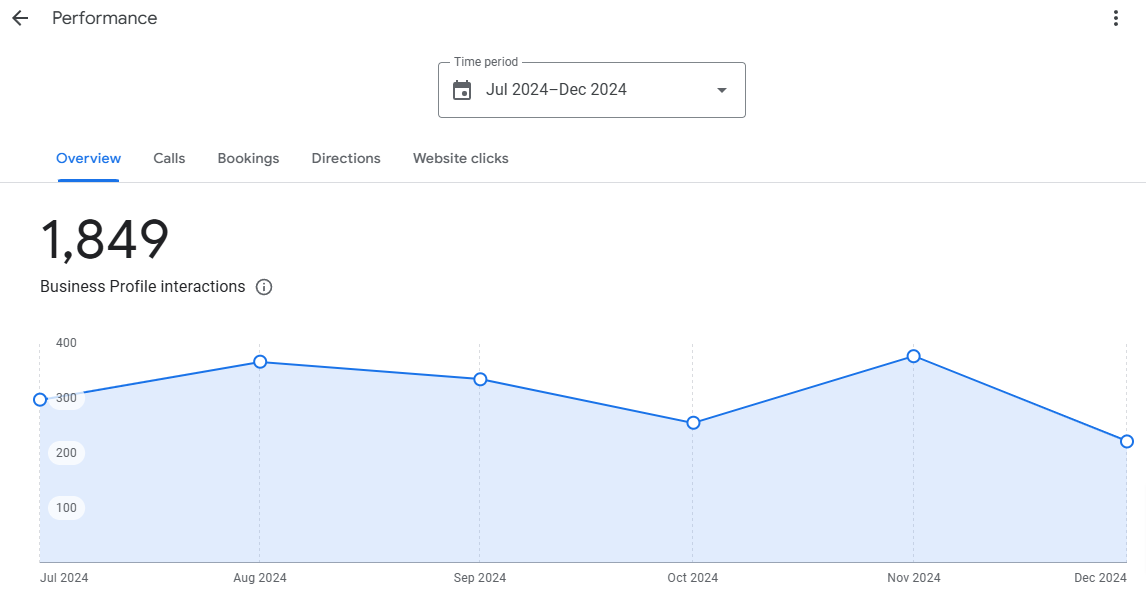
Here's the diagnostic that tells you the most. If your profile views are climbing but calls are flat, your ranking is fine and your conversion is the problem, usually too few reviews or weak photos. If both views and calls are flat, it's a ranking problem, which points back to category, citations, or authority. Knowing which of the two you have saves you from fixing the wrong thing for three months.
On timeline, be realistic. In a low-competition market you can see map-pack movement in a few months. In a saturated metro, meaningful gains take longer, and anyone promising the map pack in 30 days is selling you something.
When the profile is optimized, reviews are flowing, and the map-pack calls still aren't coming, the culprit is almost always one of three things: too few reviews, inconsistent citations, or the wrong primary category. Those are all fixable with a systematic audit. If you'd rather have someone diagnose it for you, that's what our law firm SEO team does, and you can book a free strategy call to get a straight read on what's holding your firm back in local search.
Frequently Asked Questions
What is local SEO for personal injury lawyers?
It's the work of getting your firm to show up in Google's map pack and location-based results when someone nearby searches for an injury lawyer. It centers on your Google Business Profile, online reviews, local citations, and city-specific pages, rather than the broad website content that general SEO focuses on.
How is local SEO different from regular SEO for a law firm?
Local SEO targets the map pack and "near me" searches using proximity, reviews, and your Google Business Profile. Regular (organic) SEO targets the blue-link results below the map using website content and backlinks. PI firms need both, but the map pack usually produces signed cases faster, so it's the better starting point.
How long does local SEO take to work for a personal injury firm?
In a less competitive market, you can see map-pack movement within a few months. In a saturated metro, meaningful results take longer because you're competing against firms that have been building reviews and citations for years. Any agency promising top rankings in 30 days is overselling.
Is local SEO or PPC better for personal injury lawyers?
They do different jobs. PPC and Local Services Ads buy you leads immediately, which matters if you need cases now. Local SEO takes months but compounds, lowering your cost per case over time. Most successful PI firms run both, using ads for speed and local SEO for durable, lower-cost visibility.
How many Google reviews does a personal injury firm need to rank?
There's no fixed number, but in competitive PI markets the firms in the map pack typically have hundreds of reviews. More important than a target count is steady velocity, a consistent flow of new reviews, and a rating in the 4.7 to 4.9 range. A stalled review count signals an inactive practice to Google.
Can a virtual or home-based personal injury lawyer do local SEO?
It's much harder. Google's map pack relies on a verifiable physical address and proximity to the searcher, and it actively works to catch fake or virtual locations. Firms without a real staffed office in a market usually get better returns from paid search and organic content than from trying to force map-pack visibility.
What's the biggest local SEO mistake personal injury firms make?
Two tie for first. Neglecting reviews, which are the strongest prominence signal, and building one thin "Locations" page instead of a real, unique page for each city and case type. Both quietly cap your visibility no matter how much else you do right.
Does my Google Business Profile category really matter that much?
Yes. Your primary category should be "Personal injury attorney," not the generic "Attorney." It's one of the strongest relevance signals Google uses for local rankings, and choosing the wrong one keeps you out of the searches that actually send injury cases.
Should personal injury firms create separate pages for each city they serve?
Yes, when the firm genuinely serves those areas. Each page should have unique, locally specific content, a search-matched H1, and its own citations, rather than duplicated text with the city name swapped. Thin, templated location pages don't rank and can look manipulative to Google.
How do I measure whether local SEO is actually generating cases?
Look past rankings to direct calls from your Google Business Profile performance tab, and connect those calls to signed cases through your intake tracking. Rising profile views with flat calls points to a conversion problem. Flat views and calls together points to a ranking problem.