

Personal injury is the most expensive corner of Google Ads. Not one of the most expensive. The most.
I have watched firms set $10,000 on fire in a single month and sign zero cases from it. I have also watched a solo attorney in a mid-size market build a steady flow of car accident cases on a disciplined budget. The gap between those two outcomes was never the money. It was the setup.
This guide is about personal injury and accident PPC on search, and only that. Not general law firm advertising. We will get into match types, the close-variant leak that quietly drains PI accounts, bidding, Microsoft Advertising, and the landing page and intake work that decides whether a click ever becomes a signed case. If you want the wider view first, our PPC management for law firms page covers how paid search fits next to everything else.
Why Personal Injury PPC Is a Different Game
Most PPC advice assumes you are selling a $40 product or a $200 service. Personal injury breaks that math. A single signed auto case can be worth tens of thousands in fee revenue, sometimes far more. So every competitor in your market is willing to pay for the click, and the auction price climbs to levels that would terrify a normal advertiser.
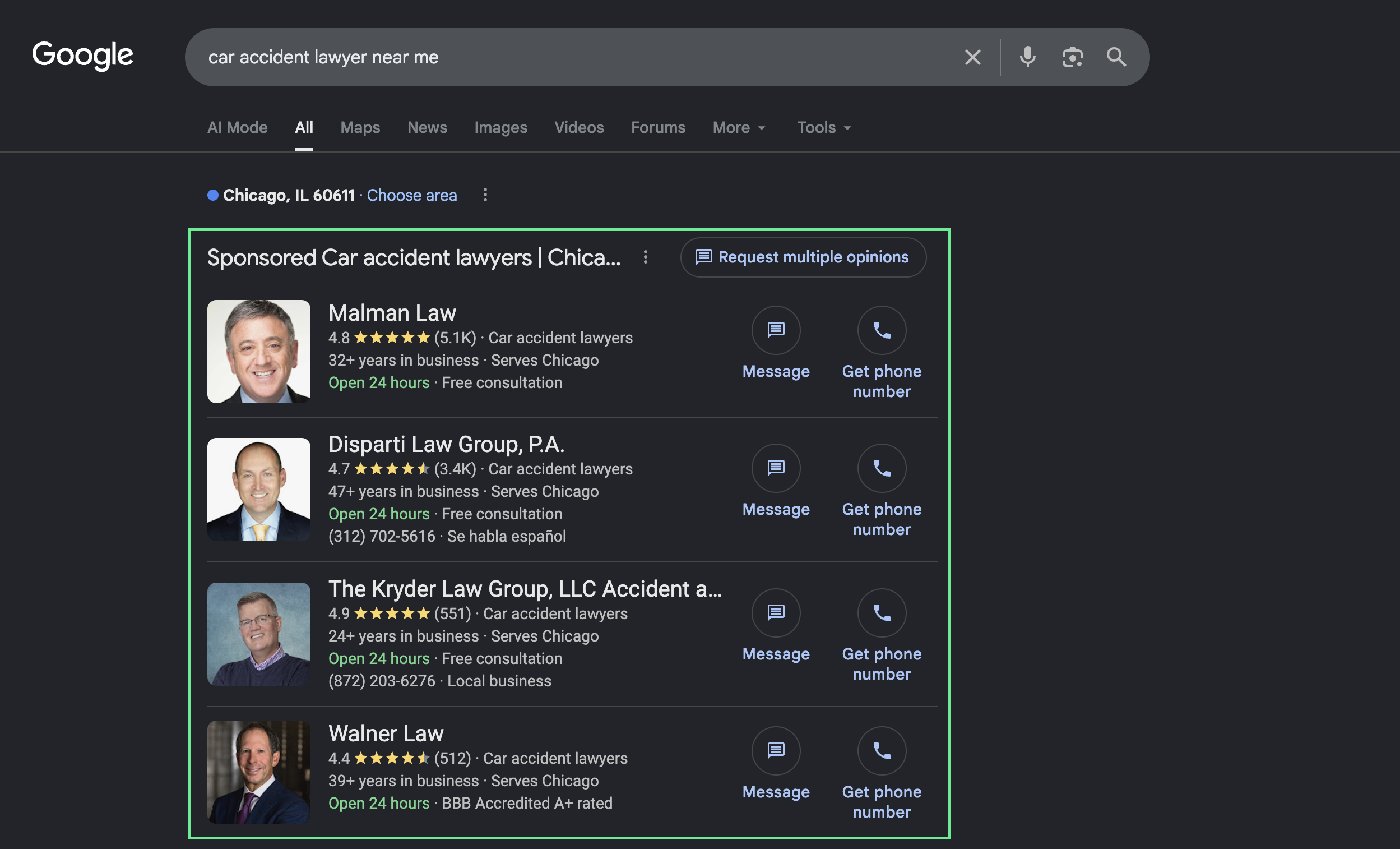
The searcher is different too. Someone who types "car accident lawyer near me" was in a wreck this week. They are not researching for later. They will call two or three firms today and hire one of them. That urgency is the whole reason PPC works here. Unlike SEO, which takes months to build, a paid ad puts you in front of that person the moment they search. Our guide to Google Ads for lawyers breaks down the mechanics of how that auction works.
There is also a rule most guides skip. Google treats accident and injury as a sensitive category, which means the retargeting playbook other businesses lean on is off the table for you. You cannot follow an accident victim around the web with ads the way a shoe brand does. Google restricts personalized advertising around personal hardship and sensitive events, and injury falls squarely inside it. Plan your campaigns as search-first, because the display and remarketing shortcuts are mostly closed. It pays to know the legal advertising rules before you write a single ad.
What a Click Actually Costs in Personal Injury
Here is the number that stops attorneys cold. In competitive markets, a click on a broad injury term can run anywhere from $50 to well over $300. I have seen individual keywords in major metros clear $200 a click before you have said a word about your firm. The generic terms are the worst offenders, because everyone bids on them and Google rewards the highest willingness to pay.
A single click can cost more than a nice dinner. Treat every one like it came out of your own pocket, because it did.
Two things drive that price. First, case value, as covered above. Second, competition density. In a city with forty injury firms fighting for the same phrase, the auction never cools off. The same keyword can cost a fraction of that in a smaller market with three competitors.
So what should you actually budget? In a mid-size market, plan on at least $3,000 to $5,000 a month just to gather enough data to make decisions, and meaningfully more in a top-25 metro. On the r/PPC forums, you will see PI advertisers running $1,000-a-day budgets and monthly spends north of $5,500, and that tracks with what serious campaigns require. If your budget is $800 a month and you are targeting "personal injury lawyer" in Los Angeles, you will spend the whole thing in a few days on a handful of clicks and learn nothing. Get the numbers right before you launch by reading our breakdown of how to set a law firm marketing budget.
Build the Campaign Around Case Type and Geography
The single biggest structural mistake I see is one campaign called "Personal Injury" holding every keyword and every city. It is impossible to control and impossible to read. Blow it apart.
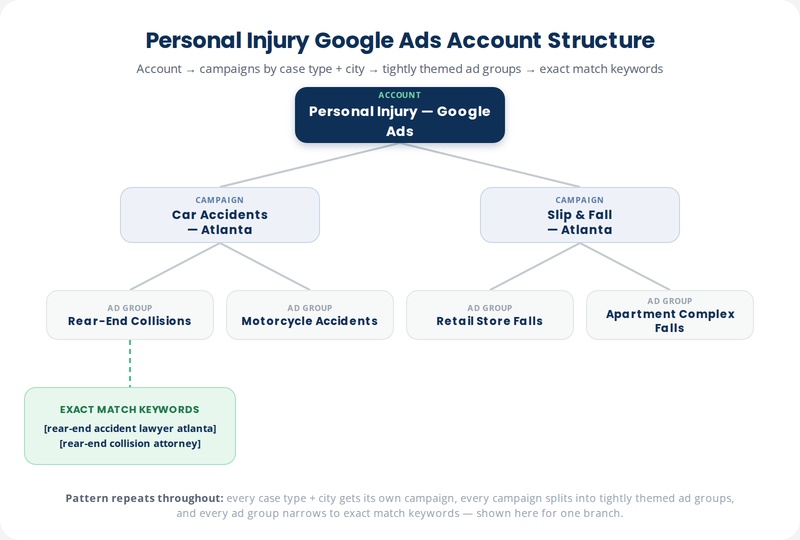
Structure around two axes: case type and service area. Car accidents behave nothing like slip and fall, and a truck accident case is worth a different number than a dog bite. Separate them so you can budget and bid each on its own merits. Then split by geography if you serve distinct markets. A firm handling car and truck accidents across two metros might run four campaigns:
- Car Accidents – Metro A
- Truck Accidents – Metro A
- Car Accidents – Metro B
- Truck Accidents – Metro B
Inside each campaign, keep ad groups tight around one theme. An ad group built on rear-end collision terms should serve an ad that says rear-end collision. That match between query, keyword, and ad copy lifts your Quality Score, and a higher Quality Score lowers what you pay per click. In a category this expensive, that discount is real money.
What about smaller or rural markets where the good keywords barely have search volume? This comes up constantly from lawyers running PPC outside major metros. Splitting hairs there starves each ad group of data. Consolidate instead. Combine closely related case types into one campaign, widen the geographic radius to cover the region you actually serve, and lean on a smaller set of high-intent terms. You want enough volume flowing through each ad group for Google to optimize and for you to judge what is working.
Keywords: Go Exact, Go High-Intent, Watch the Variants
Start narrow. In personal injury, exact match is your default, not phrase and definitely not broad. You want [car accident lawyer], [truck accident attorney], [injury lawyer near me] rather than loose variations that invite Google to spend your money on whatever it thinks is close enough. One well-chosen exact keyword per ad group is plenty.
High intent beats high volume every time. "Car accident attorney" signals someone ready to hire. "What to do after a car accident" signals someone reading a blog, and they will click your ad, cost you $80, and leave. Chase the terms that carry a decision, not the ones that carry curiosity.
In personal injury, the goal is not more clicks. It is fewer, better clicks that turn into signed cases.
Now the part that quietly wrecks PI accounts. Exact match is not as exact as the name promises. Google matches your keyword to "close variants," and left unwatched, a shocking share of your spend leaks to search terms you never chose. Advertisers regularly find half their budget landing on "Other search terms," and one attorney reported paying over $300 for the query "personal injury law book" while bidding on "personal injury lawyer." That is a client who wanted a book, not a lawyer, and it cost the price of a real lead.
The fix is not a setting. It is a habit. Open your search terms report every single week, read what people actually typed to trigger your ads, and cut anything off-target. This one routine separates PI accounts that print cases from PI accounts that print invoices. Our guide to running Google Ads for a law firm walks through where to find that report and how to act on it.
Negative Keywords Are Where PI Budgets Get Saved
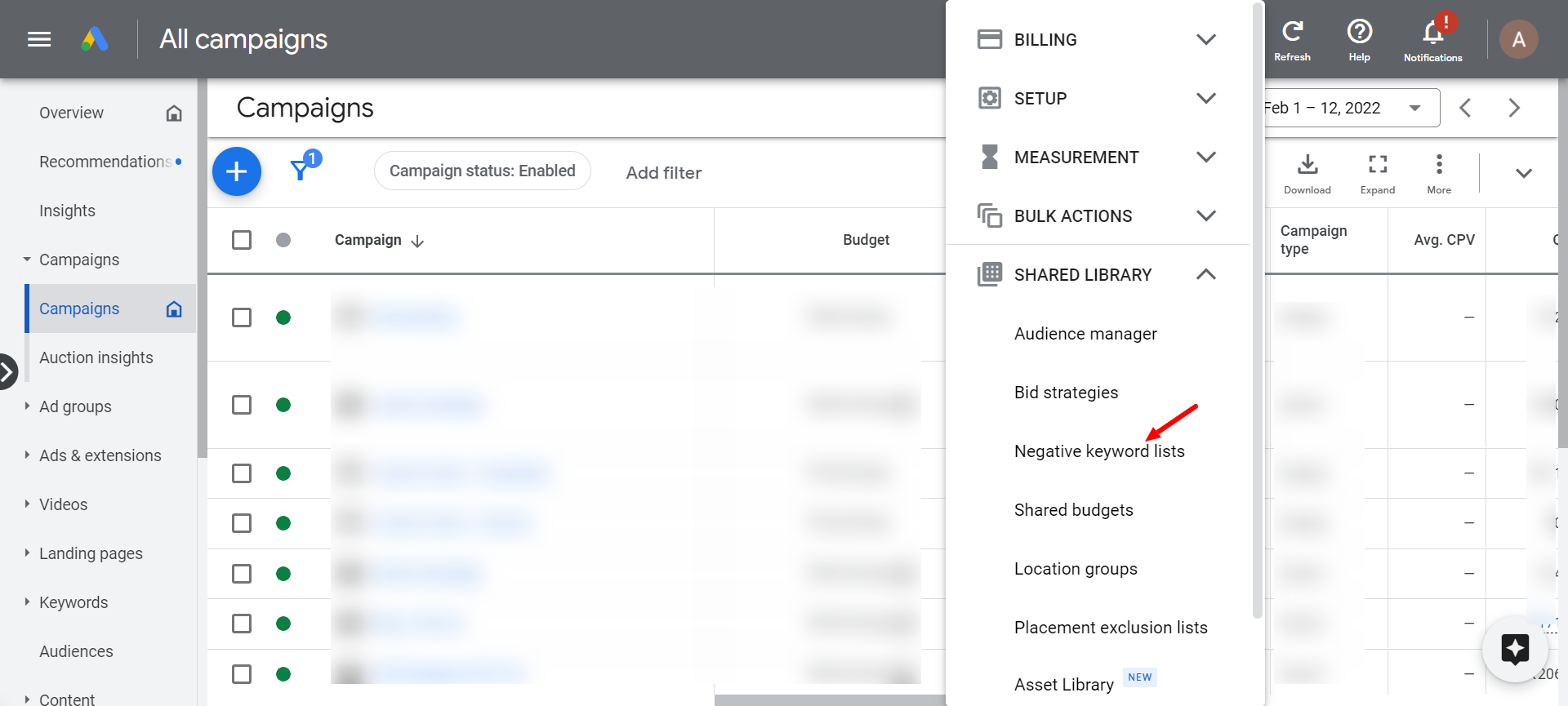
Every keyword you add tells Google where to spend. Every negative keyword tells it where to stop. In a category where one click costs $200, the negatives matter as much as the keywords.
Build your negative list before launch and grow it every week from the search terms report. A starting set for personal injury usually blocks:
- Price and freebie terms: free, pro bono, cheap, cost, "how much does a lawyer cost"
- Job seekers: jobs, salary, career, "attorney salary," internship
- DIY and research: book, reddit, calculator, "settlement calculator," "do it yourself," "how to file"
- Wrong practice or intent: criminal, divorce, workers comp if you do not take it, "law school"
Competitor names are their own headache. Some firms bid on rivals' brand terms, and you may want to block your own competitors' names so you are not paying to show up for people searching a specific other firm. The honest problem, which PI advertisers vent about often, is that you cannot possibly list every competitor in a crowded metro. Do not try to win that game with a giant negative list. Instead, tighten your match types, run a branded campaign so you own your own name cheaply, and add the biggest competitor names as negatives rather than chasing all fifty.
Bidding: Don't Hand a Cold Account to Automation
Google will happily push you toward Maximize Conversions the day you launch. Resist it. Automated bidding needs conversion data to work, and a brand-new PI campaign has none. Hand it the keys too early and it will spend aggressively while learning on your dime, which in this category means burning through a month's budget in a week.
Start with more control. Manual CPC or a Target Impression Share strategy aimed at the top of the page works well for a fresh account, and it is exactly what experienced PI advertisers recommend for launch. Impression Share bidding tells Google to keep your ad near the top for your handful of exact-match terms, which is where the ready-to-hire clicks live. Turn off Search Partners and turn off display expansion so every dollar stays on Google search, where your intent is highest.
Move to automated bidding later, once the account has real conversion history behind it. As a rule of thumb, wait until a campaign is logging a steady stream of tracked conversions each month before you switch to Target CPA or Target ROAS. Feed the algorithm clean data about which clicks became actual cases, and it gets sharp. Feed it noise, and it optimizes toward junk.
Don't Skip Microsoft Advertising (Bing)
Almost every injury firm pours its entire paid budget into Google and never opens a Microsoft Advertising account. That is a mistake, and it is a cheap one to fix.
Microsoft Advertising runs the ads on Bing, plus Yahoo, AOL, and DuckDuckGo. The audience skews older and higher income, which matters because those searchers are still getting into accidents and still hiring lawyers. The competition is thinner than Google, so the same accident keyword often clears the auction at a noticeably lower cost per click. When each Google click runs into the hundreds, paying less for a similar-intent click is worth a serious look.
The setup barely costs you time. Microsoft lets you import your Google Ads campaigns in a few clicks, so your keywords, ad groups, and copy come across without rebuilding from scratch. One caution: do not import and forget. Give Microsoft its own budget, its own negative keyword list, and its own weekly search terms review. The platforms behave differently, and a mirror of your Google account left on autopilot will underperform what a little attention would earn. For most PI firms I work with, Bing is not the main channel. It is the profitable side channel Google-only competitors are ignoring.
Landing Pages and Lead Quality Decide Your ROI
You can nail every setting above and still lose money if the click lands on a weak page. The ad's only job is to earn the click. The landing page's job is to turn it into a call.
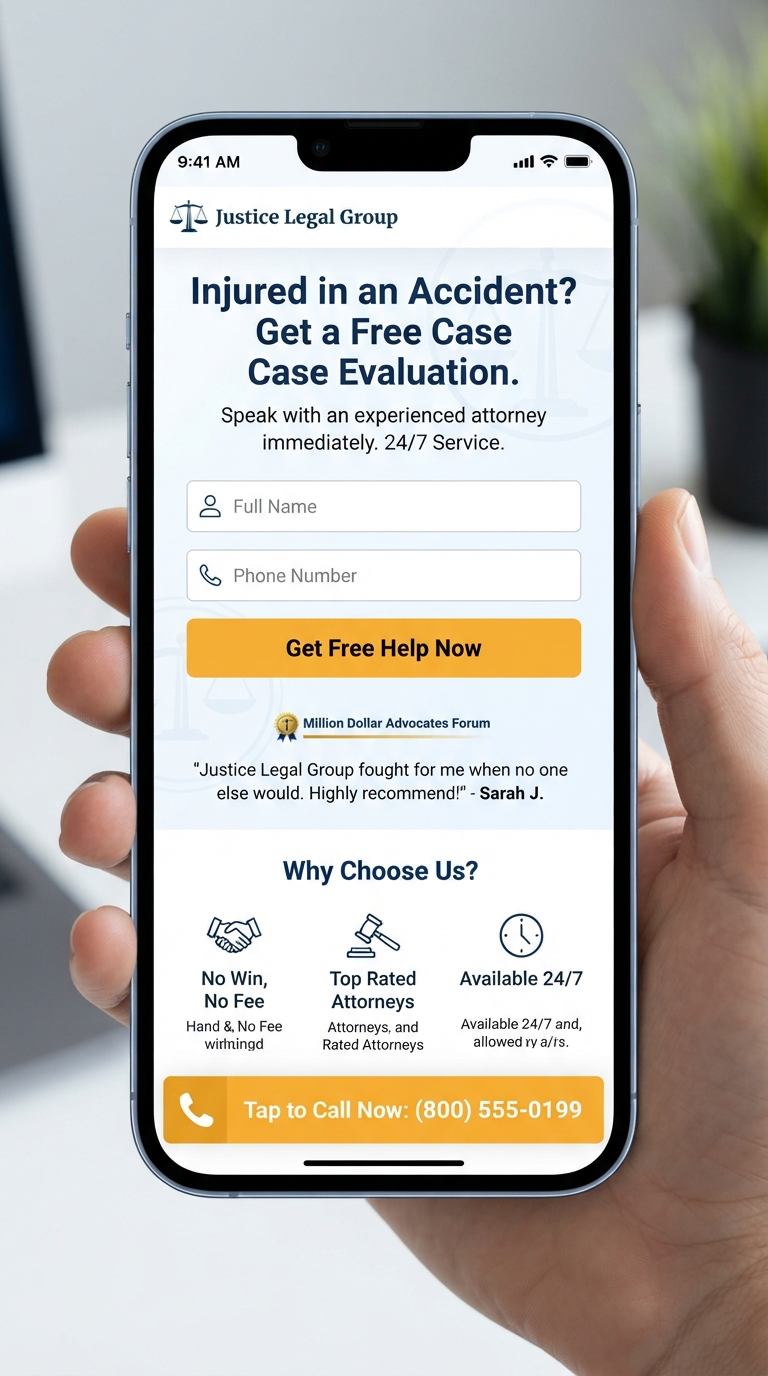
Send the click to a page that matches the ad and the case type. Someone who clicked a truck accident ad should land on a truck accident page, not your generic homepage. Put a click-to-call button above the fold, because most of these searches happen on a phone and the person wants to talk now. Keep one clear action on the page, lead with results and trust signals, cut the legal jargon, and make it load fast. Our deep dive on landing pages for lawyers covers the layout choices that move conversion rate.
Then there is the quiet truth of PI PPC: not every lead is a case. Injury advertisers openly say only a fraction of their paid leads are worth signing, and a chunk of the rest are wrong-fit, out-of-area, or outright junk. If you measure success by form fills, you will feel great while losing money. Measure signable leads and real phone conversations instead.
Two moves protect you here. First, track the right thing. Use call tracking to tie phone calls back to the exact keyword and campaign, and count qualified conversations, not raw clicks. That is the only way to know which terms produce cases, and it is the foundation of honest marketing attribution. Second, answer fast. A paid lead who called three firms will hire the one that picks up. If your intake takes hours to respond, you paid $200 to hand a case to a competitor. Speed to lead is not a nicety in personal injury. It is the difference between a signed case and a wasted click.
Where Personal Injury PPC Fits in Your Mix
Here is my honest position after years of running paid for law firms. PPC is the fastest way to get in front of accident victims, and it is the most expensive way. Both are true. Lean on it when you need cases now, when your site is new, or when you are entering a market where your organic rankings do not yet exist.
But paid search is rented visibility. Stop paying and the leads stop the same day. The firms with the lowest long-term cost per case pair PPC with organic search and content, so paid carries them while personal injury lawyer marketing builds a foundation that keeps producing after the ad spend levels off. Run them together and each dollar works harder.
If you want a second set of eyes on a campaign that is bleeding money, or you are deciding where to put your first ad budget, that is exactly the kind of thing we help injury firms sort out. Book a call and we will look at your numbers and tell you straight whether paid search is the right next move for your firm.
Frequently Asked Questions
How much does personal injury PPC cost per click?
Personal injury has some of the highest costs per click in all of Google Ads. In competitive markets, broad injury terms commonly run from $50 to over $300 per click, with generic phrases like "car accident lawyer" among the priciest. Smaller markets cost far less, but PI is expensive everywhere relative to other practice areas because a single case is worth so much.
What is a realistic monthly budget for personal injury PPC?
In a mid-size market, plan on at least $3,000 to $5,000 a month to gather enough data to optimize, and meaningfully more in a major metro. Anything much smaller gets spent in days on a few clicks without teaching you what works. Your real budget should scale with your market's competition and the case value you are chasing.
Why are my personal injury PPC leads such poor quality?
Usually it is close-variant leakage and a thin negative keyword list. Google matches your exact keywords to searches you never chose, so you pay for people looking for jobs, free help, or a settlement calculator. Review your search terms report weekly, add negatives aggressively, and measure signable leads rather than raw form fills to see the real picture.
Should personal injury lawyers use exact or phrase match?
Start with exact match. In a category this expensive, exact match gives you the most control over which searches trigger your ads. Even then, monitor close variants closely, because exact match still allows Google to match to similar queries. Phrase and broad match can be tested later, but only with a strong negative list and a lot of attention.
Do negative keywords really matter for personal injury ads?
They matter as much as the keywords themselves. When one click costs $200, blocking terms like free, jobs, book, and settlement calculator saves real money every week. Negative keyword management is not a one-time task. Build the list before launch and add to it every time you read the search terms report.
Is Bing (Microsoft Advertising) worth it for personal injury firms?
For most firms, yes, as a profitable secondary channel. Microsoft Advertising reaches an older, higher-income audience across Bing, Yahoo, and DuckDuckGo, usually with less competition and lower costs per click than Google. You can import your Google campaigns in minutes, but give Bing its own budget, negatives, and weekly review rather than running it on autopilot.
Can personal injury lawyers use retargeting or remarketing?
Mostly no. Google treats accidents and injuries as a sensitive category and restricts personalized advertising around personal hardship, which rules out the standard remarketing playbook for injury victims. Build your strategy around high-intent search instead, where you reach people at the exact moment they are looking to hire.
How do I stop wasting money on irrelevant clicks?
Three habits. Use exact match on high-intent terms, read your search terms report weekly and cut off-target queries, and keep a growing negative keyword list. Turn off Search Partners and display expansion so your budget stays on Google search. Most wasted PI spend traces back to skipping one of these.
Is PPC or SEO better for personal injury law firms?
They do different jobs. PPC delivers cases immediately but stops the day you stop paying. SEO takes months to build but keeps producing leads at a lower long-term cost. The strongest injury firms run both, using paid search for speed while organic search builds a durable foundation. Relying on PPC alone leaves you renting all of your visibility.
How fast should I follow up with a personal injury PPC lead?
Within minutes, not hours. An accident victim who clicked your ad almost certainly contacted other firms too, and they tend to hire whoever responds first. If your intake is slow, you are paying premium click prices to hand cases to competitors. Fast, human follow-up is one of the highest-return fixes in personal injury PPC.
What bidding strategy should a new personal injury campaign start with?
Start with manual CPC or a Target Impression Share strategy aimed at the top of the page, not Maximize Conversions. Automated bidding needs conversion history to work, and a new account has none. Once the campaign logs a steady stream of tracked conversions each month, you can test Target CPA or Target ROAS with clean data behind it.