

Most law firms I audit have the same problem, and it isn't their website copy or their Google Business Profile. It's that almost no other website vouches for them. Their backlink profile is a ghost town. And in a field where Google leans hard on trust signals, that quiet is expensive.
Links are how the web says "this firm is worth paying attention to." Google has rewritten its ranking systems thousands of times, yet backlinks have survived every update as a core signal. If you want to rank for the searches that actually bring in cases, you have to earn them.
This guide is the practitioner version. Not "build backlinks and post great content," but the actual playbook: which links move the needle, the outreach numbers nobody publishes, and a data-backed ranking of the ten legal directories worth your money. Let's get into it.
Key Takeaway
One relevant link from a trusted legal source outperforms fifty from random blogs. In link building, the entire game is quality and relevance, not volume.
What a Backlink Actually Is
A backlink is a link on someone else's website that points to yours. That's it. People also call them inbound links, and you can think of each one as a public recommendation. When a bar association, a legal news outlet, or another attorney links to your firm, they're telling Google their audience should see you.
Before we go further, four terms trip people up. Worth clearing them up now so the rest of this makes sense.
- Backlink (inbound link): a link from another site pointing to yours. This is what moves rankings the most.
- Internal link: a link between two pages on your own site. These don't build outside authority, but they spread it around and help Google understand your site.
- External link: a link from your site out to another. Useful for citing sources and building trust with readers.
- Anchor text: the clickable words the link sits on. "New York DUI lawyer" tells Google something very different than "click here."
Not every backlink is built the same way, either. A few types you'll run into:
- Editorial links get placed inside real content because a writer decided your page was worth citing. These are the gold standard, and they're often how you turn media coverage for your firm into ranking power.
- Directory links come from listing your firm on legal directories like Justia or Avvo. Easy to get, still valuable when the directory is reputable.
- Guest post links come from writing an article for another site and linking back to yours.
- Acquired links are paid or placed. Tread carefully here, because Google treats undisclosed paid links as a policy violation.
Now, internal linking. It won't build authority from the outside, but it decides where the authority you earn actually goes. When you land a strong link to one blog post, internal links pass a share of that value to your money pages, your practice area pages, your contact page. A firm with 200 orphaned pages and no internal structure wastes most of the link equity it works so hard to earn. Link your related content together on purpose. It's the cheapest SEO win most firms ignore.
For the groundwork every firm should lay before chasing advanced tactics, start with our guide to foundational link building strategies.
Why Backlinks Decide Law Firm Rankings
Google's job is to figure out which pages to trust for a given search. On most queries, it can lean on content and user behavior. For legal searches, the bar is higher.
Law falls under what Google calls Your Money or Your Life topics, content that can affect someone's finances, safety, or legal standing. Google holds these pages to a stricter standard for expertise and trust. A backlink from a respected legal source is one of the strongest ways to show you belong. That's also why our guide to E-E-A-T and YMYL for law firms spends so much time on off-site signals.
Here's what earning real links does for a firm, in plain terms.
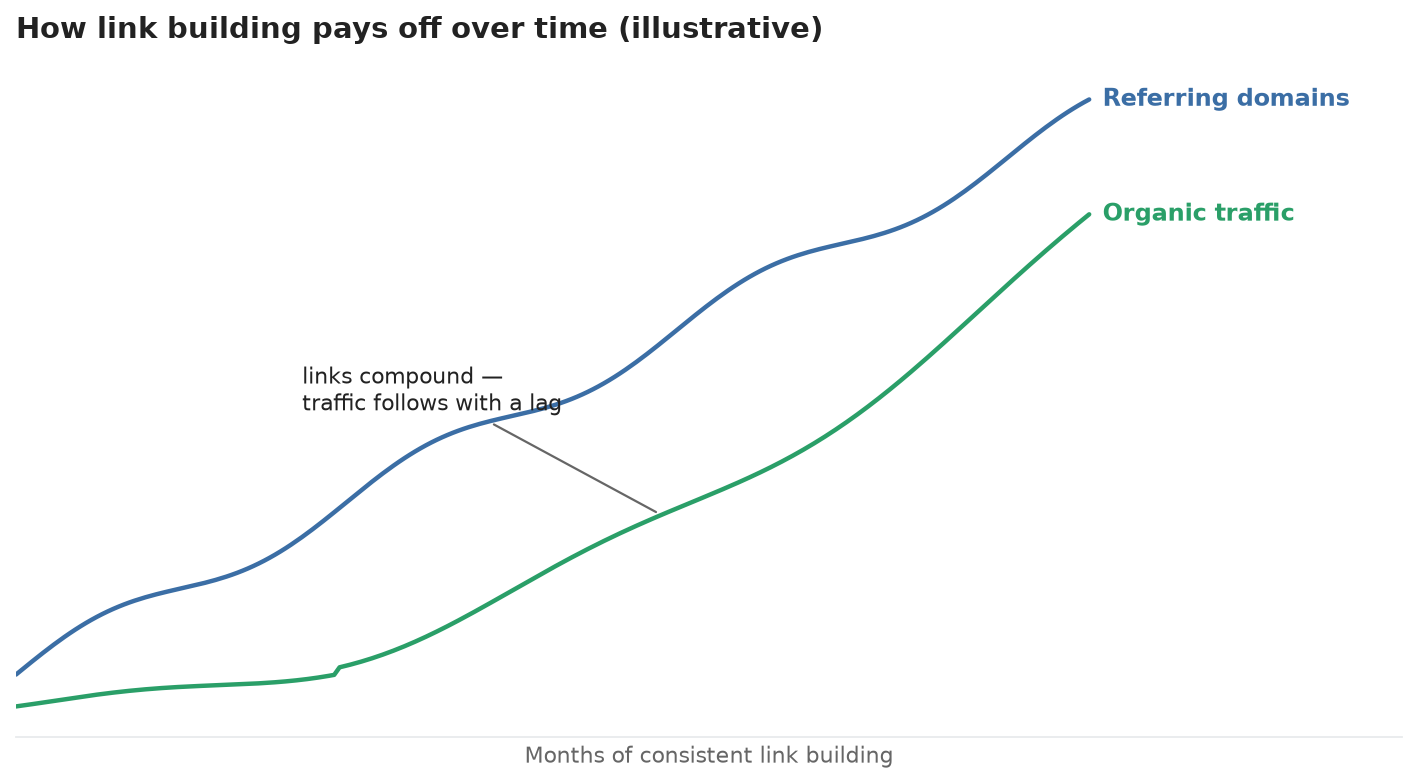
It lifts your rankings. More trusted sites vouching for you means Google is more willing to rank you for competitive terms. Ahrefs' study of over a billion pages found a clear pattern: pages with more referring domains tend to pull more organic traffic. The correlation isn't subtle.
It sends you qualified traffic. A link inside an article on a legal aid site or a local news story doesn't just help SEO. It sends readers who are already thinking about legal problems straight to your door.
It compounds. A good backlink profile is durable. Firms that build one keep their rankings through algorithm updates that wipe out competitors relying on thin tactics. You're building an asset, not renting a position.
The catch is that none of this is fast. In my experience, most firms start seeing meaningful ranking movement three to six months into consistent link building, and competitive markets can take longer. That's not a reason to wait. It's a reason to start now.
What Makes a Backlink Worth Having
You could earn a hundred links this month and move your rankings zero. You could earn three and jump a page. The difference is quality. Four things separate a link that helps from one that does nothing, or worse.
Relevance
A link from a legal site beats a link from a random blog every time. When a personal injury directory or a local bar association links to you, Google sees a topical match and counts it heavily. A link from a shoe store? Close to worthless. Chase links from the legal and local world you actually operate in.
Authority
Links from established, trusted sites carry more weight. One way to gauge this is domain rating, Ahrefs' 0-to-100 score for a site's link strength. Government sites, universities, and major legal publications sit at the top. Don't obsess over the exact number, but a link from a site with real authority is worth many from weak ones.
Placement
Where the link sits matters. A link inside the body of an article, surrounded by relevant text, passes more value than one buried in a footer or a sidebar list. Editorial placement in real content is what you want.
Dofollow vs. nofollow
A dofollow link tells Google to count the endorsement. A nofollow link tells it not to pass ranking value, though it can still send you traffic and brand exposure. You want a natural mix. A profile that's 100% dofollow from exact-match anchors looks manipulated, and Google notices.
Key Takeaway
A backlink profile is your firm's online reputation in Google's eyes. It's better to have no link than a toxic one.
The links to avoid
Some links actively hurt you. Steer clear of these:
- Links from spammy, low-quality, or unrelated sites
- Private blog networks (PBNs) and link farms built to game rankings
- Undisclosed paid links
- Sitewide footer or sidebar links stuffed with exact-match anchor text
- Comment spam and low-effort forum drops
This isn't caution for its own sake. Google's link spam policy spells out that links meant to manipulate rankings can trigger a manual action, and clawing your way back from one costs months. In a field where your online reputation and your professional reputation are the same thing, the risk isn't worth it. Build slow and clean.
Attorney Link Power: The Directories Worth Your Time
Every link building guide tells you to "get listed in legal directories." Almost none tell you which ones are actually worth it. So we ran the numbers ourselves.
We started from our internal vetted list of legal directories and scored each one. The result is a metric we call Attorney Link Power, and as far as I know, no other guide publishes anything like it. Here are the top ten.
| # | Directory | Monthly organic traffic | Spam score | Attorney Link Power |
|---|---|---|---|---|
| 1 | justia.com | 3,244,632 | 3 | 97 |
| 2 | superlawyers.com | 1,600,250 | 5 | 91 |
| 3 | bestlawyers.com | 292,776 | 4 | 81 |
| 4 | findlaw.com | 992,593 | 16 | 77 |
| 5 | lawinfo.com | 180,554 | 12 | 71 |
| 6 | abogado.com | 144,847 | 11 | 71 |
| 7 | lawyers.com | 55,285 | 17 | 60 |
| 8 | martindale.com | 39,304 | 15 | 60 |
| 9 | lawcrossing.com | 34,150 | 15 | 59 |
| 10 | lawyer.com | 3,546 | 18 | 45 |
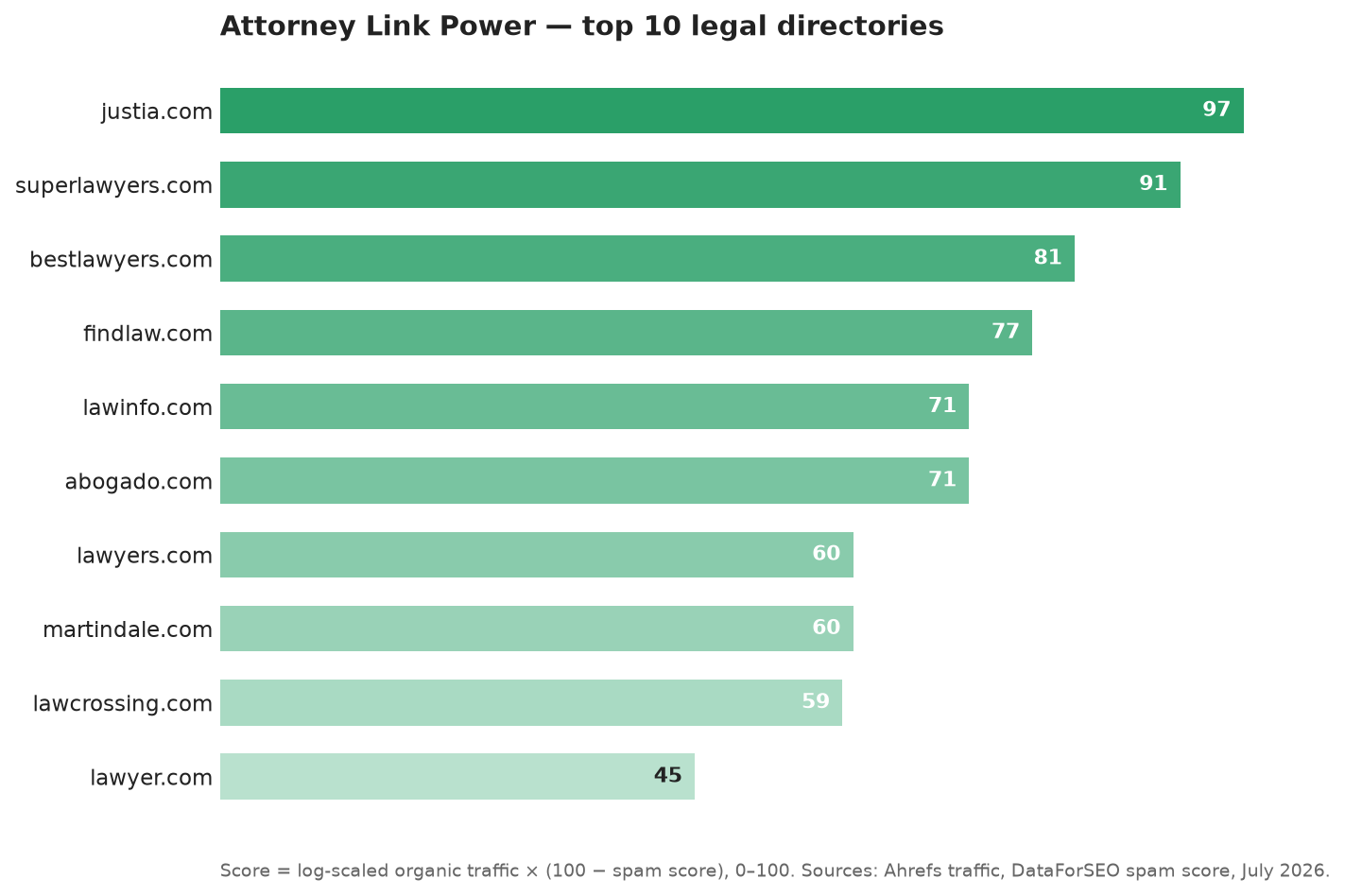
Data pulled July 2026. Organic traffic via Ahrefs, backlink spam score via DataForSEO.
A couple of notes on the list. Super Lawyers ranks attorney profiles on attorneys.superlawyers.com, so that's the property your listing actually lives on. And abogado.com earns its spot as a Spanish-language directory, which makes it genuinely useful if you serve Spanish-speaking clients and want links that match that audience.
How we scored it
Attorney Link Power is built to answer one question: how much is a link from this directory actually worth to a law firm? We started with our vetted directory list and kept only sites that cleared two gates. First, real organic traffic, meaning at least 1,000 monthly visits in Ahrefs. Second, a DataForSEO backlink spam score under 50. Anything dirtier got cut.
For the survivors, we scored each directory by log-scaled organic traffic multiplied by (100 minus its spam score), then normalized the result to a 0-to-100 scale. That's the Attorney Link Power number. When two directories tie, raw traffic breaks it.
What got cut, and why it matters
The exclusions tell you as much as the list. We cut thelaw.com (spam score of 50, right at the line), morelaw.com (a spam score of 87, well into toxic territory), and four smaller directories that couldn't clear 1,000 monthly visits. If a directory can't clear a low bar for traffic and a clean bar for spam, a link from it isn't doing your firm any favors.
Here's the finding I'd frame and hang on the wall. Look at findlaw.com. It pulls nearly a million monthly visits, roughly three times the traffic of bestlawyers.com. Yet it ranks below Best Lawyers on our list. Why? Its spam score is 16 against Best Lawyers' 4. A messy backlink profile discounts a directory's value even when the traffic looks impressive. Raw traffic is a vanity number. A clean, trusted link profile is what actually transfers to your firm.
Key Takeaway
Traffic gets a directory in the door. A clean backlink profile is what makes its link worth having. When you have to choose, pick the cleaner site.
Directories are the fastest, most reliable links a firm can build, which is why they anchor the playbook below. For a wider look at which platforms are worth paying for, see our breakdown of the best legal directories for law firms and what to expect from legal directory costs.
The Law Firm Link Building Playbook
You know what a good link looks like. Now here's how to actually earn them. These are the tactics that consistently work for law firms, ordered roughly from easiest to hardest. Start at the top.
1. Claim and complete your directory profiles
This is your first move, full stop. The directories in the table above already have authority with Google, so a complete profile earns you a trusted link fast. Don't stop at a name and phone number. Fill in practice areas, recent case results, client reviews where the platform allows, awards, and speaking history. A thin profile ranks poorly and looks lazy to prospects. Set a calendar reminder to refresh these quarterly. Active profiles outperform stale ones.
2. Build content other lawyers actually cite
The most durable links come from content so useful that people link to it without being asked. In the legal world, that usually means one of a few formats: a plain-English guide to a confusing state law, an original data breakdown, or a tool that answers a real question. One state-specific misdemeanor guide we built for a client kept earning citations from journalists and legal blogs long after we published it, because it filled a gap nobody else had covered well.
Before you write anything, search "[your topic] + statistics" or "[your topic] + cite" in Google. That shows you what kind of content already attracts links in your niche, so you can build something better. Our guide to legal content marketing goes deeper on this.
3. Guest post on non-competing legal sites
Guest posting still works when you do it right. The move is to write for attorneys you don't compete with, a family law firm in another state, a legal tech blog, an adjacent practice area. You give them genuinely useful content, and you get a relevant link back.
Non-competitors are the key. You'll never convince a rival firm across town to host your byline, but a colleague two states away usually will. It's a numbers game, so don't lose heart when the first few pitches go nowhere. Publications like JD Supra and the National Law Review actively take expert contributions, and landing one often opens the door to more.
4. Get quoted by journalists
Reporters need expert sources on deadline, constantly. Services like Featured (the successor to HARO), Qwoted, and Help a B2B Writer send daily requests from journalists looking for exactly the kind of commentary an attorney can give. A single response that lands can earn you a link from a major news outlet, the kind of authority you can't buy.
Speed and specificity win here. Journalists usually pick from the first few solid responses, so answer fast, keep it quotable, skip the sales pitch, and include your credentials. One habit worth building: when a reporter quotes you but forgets the link, a polite follow-up recovers it more often than you'd expect.
5. Start or guest on a legal podcast
Podcasts are an underrated link source. Every episode generates show notes, a guest profile, and directory listings, most of which link back to your site. Running your own niche show builds authority over time, but the faster path is guesting on established legal podcasts. Book a handful of appearances and you'll pick up profile links and show-note links from each one.
6. Earn local and community links
This is where law firms have an edge most industries don't. You're a real business in a real place, and local links are both easy to earn and unusually valuable for local search. Sponsor a youth sports team, a 5K, or a local nonprofit event, and you typically get a link from their site. Join your chamber of commerce. Offer a scholarship. Host a free legal clinic and get covered by local press.
These links do double duty: they build authority and they strengthen your local SEO, which we'll get to shortly.
7. Reclaim your unlinked brand mentions
This one is almost free, and most firms never do it. Your firm gets mentioned online more than you think, in news stories, directory posts, roundups, event pages. A lot of those mentions never include a link. Search your firm's name in Google (in quotes), find the pages that mention you without linking, and email the site owner a short, friendly note asking them to link the mention. You're not asking for a favor. You're asking them to complete a reference they already made. The reply rate on these beats cold outreach by a wide margin.
Not sure where your firm's link gaps are?
In 15 minutes, I'll review your current backlink profile and show you exactly where the opportunities are.
Schedule a Free Consultation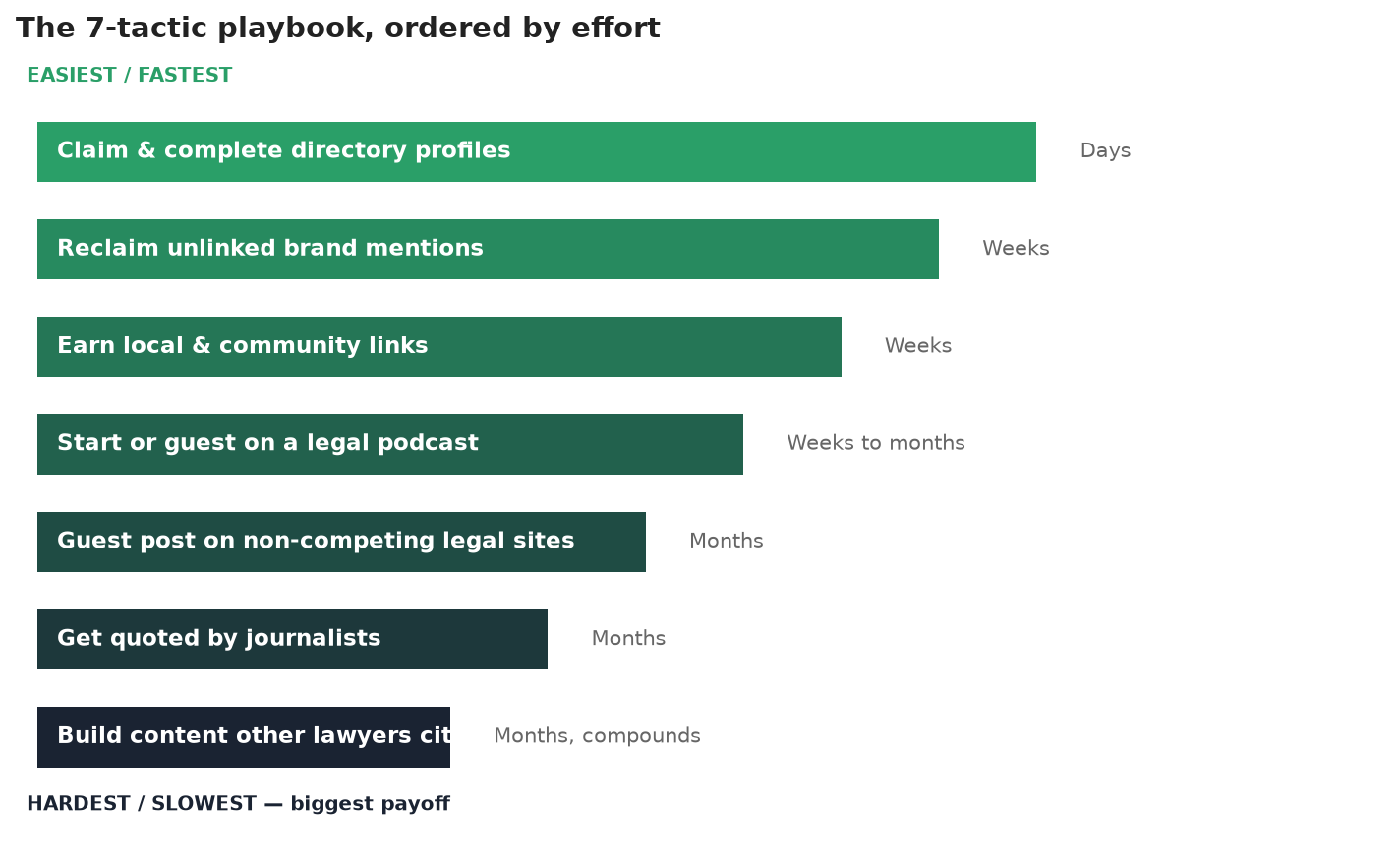
The Outreach Math Most Guides Skip
Here's what almost no other guide will tell you: the real numbers. Link building outreach is a conversion funnel, and if you go in expecting everyone to say yes, you'll quit in week two. So let me set honest expectations from what we see running these campaigns.
Cold guest post outreach converts in the single digits. Send a relevant, personalized pitch to a legal blog, and a reply rate around 10 to 15 percent is healthy. Actual placements land lower, often 5 to 8 percent of what you send. To place four guest posts, plan on reaching out to fifty or more well-chosen targets. Generic mass emails do far worse, which is why personalization isn't optional.
Journalist outreach is a volume game with a big payoff. On a service like Featured, expect to send 15 to 25 thoughtful responses to land one quality placement. That sounds brutal until you remember a single placement can be a link from a national news site. The math works because the prize is large.
Unlinked mention reclamation is your best ratio by far. Because the site already mentioned you, conversion often runs several times higher than cold outreach. If your time is limited, start here.
What about cost? If you outsource, a genuinely quality editorial placement usually runs somewhere between $200 and $600 through a reputable service. When someone offers to "sell you a link" on a legal site for a flat fee, be careful. That's often a paid link dressed up as a guest post, which puts you on the wrong side of Google's policy. Premium directory listings are a separate line item, ranging from free up to well over a thousand dollars a year depending on the platform. Our guide to what legal directories cost breaks those down.
The honest takeaway: a focused firm doing this consistently can earn two to four quality links a month. That doesn't sound like much. Compound it over a year and it's the difference between a ghost-town profile and one that ranks.
Link Building and Local SEO
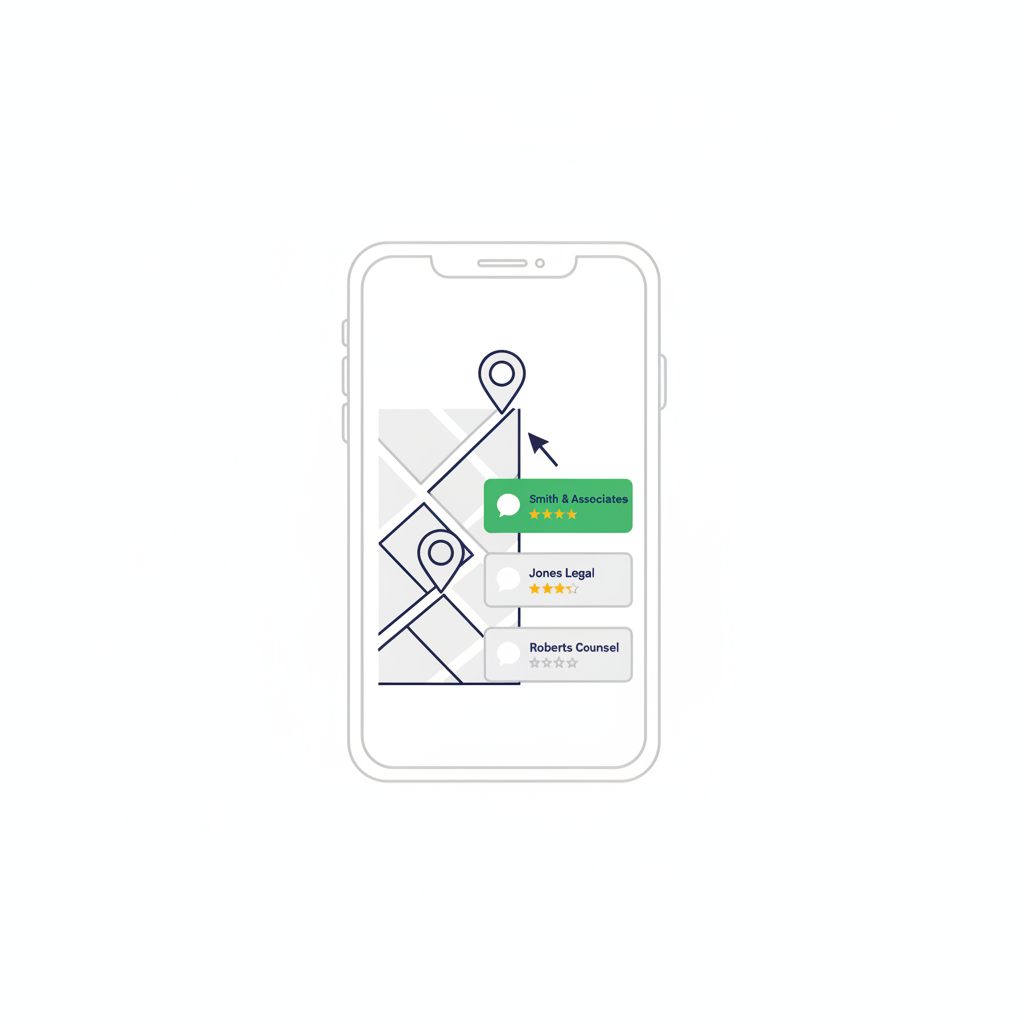
For most firms, the real prize isn't ranking nationally. It's owning the searches happening in your own city. "Car accident lawyer near me." "Estate planning attorney [your town]." Links play a specific and often underrated role in winning those.
Google's local rankings weigh signals a little differently. Alongside your Google Business Profile and your reviews, local relevance matters, and links are one of the clearest ways to prove it. A link from your city's chamber of commerce, a local news outlet, or a neighborhood nonprofit tells Google you're genuinely embedded in that community. National directory links build broad authority. Local links build geographic relevance. You want both.
This is why the community tactics from the playbook punch above their weight. Sponsoring a local event might feel small next to landing a national news link, but for a firm fighting to win the map pack in its own city, that local sponsorship link can matter more. Pair your link building with the rest of your local SEO strategy and the two reinforce each other.
For local firms, a link from a respected organization in your own city can outperform a higher-authority link from across the country. Geographic relevance is its own signal.
How to Measure Whether It's Working
Link building without measurement is just hoping. But most firms track the wrong thing, obsessing over raw link count. Total links is a vanity metric. Here's what actually tells you if the work is paying off.
Referring domains, not total links. Fifty links from one site count for far less than links from fifty different sites. Watch the number of unique domains pointing to you, and watch the quality of the new ones. Ten clean, relevant referring domains beat a hundred junk links.
Rankings for the terms that bring cases. Track where you sit for your money keywords, the ones with real client intent. If those are climbing as your links grow, the strategy is working. If they're flat after six months of clean effort, something upstream needs a look, usually your on-page content or site structure.
Referral traffic and, eventually, cases. Some of your best links send visitors directly. In Google Analytics, watch which referring sites send people who actually contact you. A directory or article that sends real prospects is worth more than its ranking value alone.
Check your backlink profile monthly in Ahrefs or Google Search Console. Watch for sudden drops, and watch for spammy links appearing that you didn't build. If toxic links show up, Google's own guidance on the disavow tool covers when it's worth acting. For most firms building clean links, you'll rarely need it.
Set the expectation up front: months one through three are foundation, months four through six bring the first real gains, and the compounding authority shows up after that. Firms that stick with it stop competing on price and start competing on trust. If you'd rather hand the whole system to a team that does this for law firms every day, that's what we do at Constellation. Either way, the firms that win are the ones that treat link building as an ongoing habit, not a one-time project.
Frequently Asked Questions
How long does link building take to improve law firm rankings?
Most firms see meaningful movement three to six months into consistent link building, with competitive markets taking longer. The compounding benefit shows up after that. It's a long game, but the rankings you earn this way tend to hold through algorithm updates.
How many backlinks does a law firm need to rank?
There's no magic number, and chasing one is the wrong mindset. What matters is referring domains and their quality. Ten clean, relevant links from trusted legal and local sites will outperform a hundred low-quality links. Focus on quality and relevance, not a target count.
Are legal directories still worth it for backlinks?
Yes, when you pick the right ones. Reputable directories like Justia, Super Lawyers, and Best Lawyers carry real authority and low spam scores, which makes their links genuinely valuable. Directories with heavy spam profiles or almost no traffic aren't worth your time. Our Attorney Link Power ranking above shows which ones clear the bar.
Can buying backlinks get my law firm penalized?
It can. Google's link spam policy treats undisclosed paid links as a violation that can trigger a manual action, which can tank your rankings for months. Paying a reputable service to earn editorial links through outreach is fine. Paying a site directly to place a link is the risky version. Know the difference.
What's the difference between a backlink and an internal link?
A backlink comes from another website and points to yours, which builds outside authority. An internal link connects two pages on your own site. Internal links don't create authority from scratch, but they spread the authority you've earned to your most important pages, so both matter.
Do nofollow links help law firm SEO?
Nofollow links don't pass direct ranking value, but they still send referral traffic and build brand awareness, and a natural profile includes a healthy mix of both. A backlink profile that's entirely dofollow with exact-match anchor text looks manipulated, so don't dismiss nofollow links.
What is HARO and does it still work for lawyers?
HARO connected journalists with expert sources. It has been folded into Featured, and alternatives like Qwoted and Help a B2B Writer do the same thing. For attorneys, it still works well. Reporters constantly need legal commentary, and one strong response can earn a link from a major news outlet.
How do local backlinks help my law firm?
Local links, from your chamber of commerce, local news, or community organizations, prove to Google that you're genuinely part of your city. That geographic relevance directly supports your local pack and "near me" rankings. For firms competing in a specific market, a local link can matter more than a higher-authority national one.
Should I hire an agency for link building or do it myself?
Directory profiles, unlinked mention reclamation, and local sponsorships are very doable in-house and a smart place to start. Scaled guest posting and journalist outreach take time and relationships most firms don't have to spare. If you'd rather focus on practicing law, that's when an agency earns its keep.
What backlinks should law firms avoid?
Avoid links from spammy or unrelated sites, private blog networks, link farms, undisclosed paid placements, and comment or forum spam. A single toxic link won't sink you, but a pattern of them can. When in doubt, it's better to have no link than a harmful one.