

Why Generic Marketing Fails Real Estate Law Firms
Real estate clients don’t think like personal injury plaintiffs or divorce clients. They’re not searching for empathy—they’re searching for competence under pressure. A residential buyer closing in 30 days needs a lawyer who understands title issues, inspection contingencies, and lender requirements. A commercial developer needs counsel who speaks fluently about zoning, financing structures, and regulatory compliance. They’re making six-figure decisions with strict timelines, and they know exactly what they don’t know.
Real estate law firm marketing speaks to your client’s specific needs. Generic legal marketing—the kind built on testimonials and “we fight for you” messaging—fails real estate firms because it ignores this reality. Your clients evaluate you on technical capability and responsiveness, not emotional connection. They compare you against competitors they’ve already vetted. They often contact you after their real estate agent, lender, or previous transaction attorney recommended you by name.
Real estate law marketing requires a different architecture: demonstrating deal-specific expertise, proving your turnaround speed on closings, showing you understand the specific transaction types your market demands, and positioning you as the lawyer other professionals actually trust. Generic approaches waste your budget on prospects who will never close. Specialized real estate marketing invests your money in people already pre-qualified and ready to hire.
Who Real Estate Clients Are—And What They’re Actually Looking For
Your ideal real estate clients aren’t passive searchers. They’re investors closing on a commercial portfolio, homebuyers facing title disputes, developers navigating zoning complications, or businesses relocating and discovering landlord-tenant conflicts mid-lease. They search when friction appears: a title company flags a lien, a deal stalls in due diligence, or a neighbor’s encroachment threatens development plans.
These clients don’t need reassurance about your credentials—they need proof you’ve solved *their specific problem*. A residential buyer facing a title defect searches for “title defect attorney near me” or “property dispute lawyer”—they want case outcomes, not firm history. A commercial developer looks for precedent: Have you negotiated complex easements? Resolved zoning variances? Guided other developers through similar regulatory hurdles?
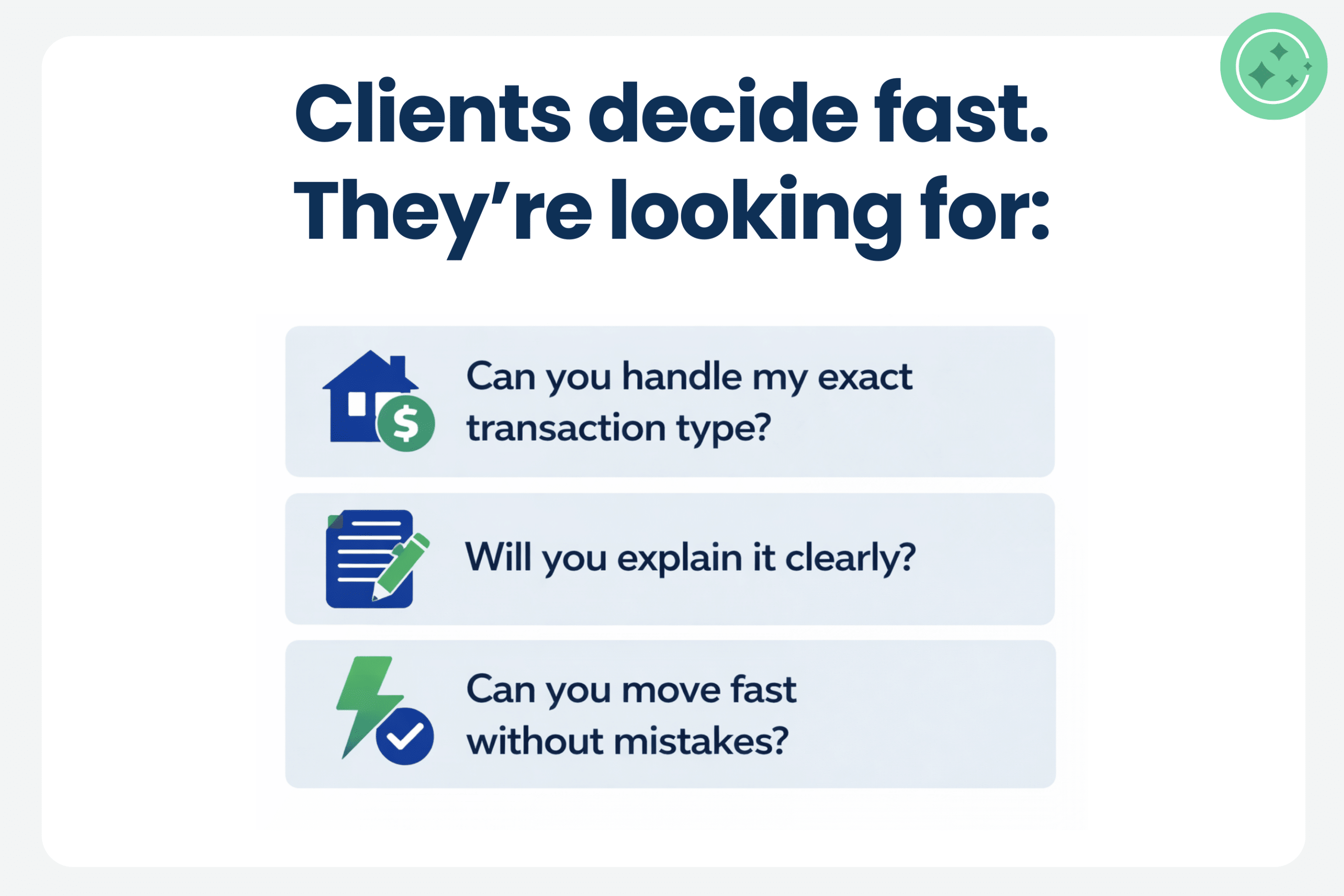
Before contacting your firm, they mentally answer three questions: Can you handle my exact transaction type? Will you explain the process without legal jargon? Can you move quickly without cutting corners? They expect your website and content to demonstrate competency in *their* market segment—residential, commercial, development, or investment—not generic real estate law.
Your marketing must address the fear beneath the search: deals falling through, capital tied up, legal exposure, or regulatory delays. Show them you’ve protected others in their position.
How a Real Estate Law Firm Website Should Be Built
Real estate clients demand clarity and reassurance before engaging counsel. Your website must function as both educational resource and credibility fortress, addressing the specific anxieties of property buyers, sellers, developers, and investors navigating complex transactions.
A high-converting real estate law firm website prioritizes transaction clarity, regulatory expertise visibility, and rapid client qualification. Your homepage should immediately establish which transaction types you handle—residential closings, commercial acquisitions, title disputes, or development matters—eliminating visitor confusion. Real estate clients are often time-pressed and documentation-heavy; your site must reduce friction by offering downloadable checklists, transaction timelines, and fee transparency upfront.
Trust signals matter intensely in real estate law. Prominently display bar admissions, specialized certifications (ABA real property sections), years in practice, and transaction volume. Include client testimonials specific to transaction outcomes—not generic praise, but results like “Closed on schedule despite title complications” or “Recovered $180K in disputed earnest money.” Case studies demonstrating problem-solving (zoning challenges resolved, closing timeline acceleration) convert better than vague success stories.
Key Website Features:
-
Transaction cost calculators allowing clients to estimate closing costs by property type and value, eliminating surprise conversations
-
Title issue resource library addressing common problems (liens, easements, boundary disputes) with SEO-optimized educational content
-
Real-time availability scheduling for consultation bookings, reducing back-and-forth email delays
-
Regulatory compliance documentation showcasing state-specific disclosures, escrow handling, and compliance protocols
-
Before-and-after case studies demonstrating complex transaction resolutions with measurable client outcomes
SEO Strategy for Real Estate Law Firm Marketing
Real estate law firms operate in a hyperlocal market where geographic targeting outperforms national campaigns. Your SEO strategy must balance location-specific keywords with practice-area authority signals that Google recognizes as trustworthy for legal services.
Start with location-modifier searches your ideal clients actually use: “real estate attorney near ,” “property lawyer ,” and “real estate transaction attorney .” These convert higher than generic terms because they capture active buying intent. Layer in practice-specific modifiers like “commercial real estate attorney,” “residential real estate closing,” and “real estate litigation lawyer ” to target prospects with defined legal needs.
Build authority through Google Business Profile optimization—critical for local pack rankings—and create location-specific landing pages for each city or county you serve. This addresses the reality that a real estate client in Miami has entirely different needs than one in Denver.
Content strategy should emphasize buyer-facing topics: closing processes, title issues, property dispute resolution, and 1031 exchanges. This attracts prospects at decision stage, not awareness stage. Include local case studies and market-specific insights (zoning challenges in your area, market trends affecting transactions).
National expansion requires different tactics: build topical authority through pillar content on commercial vs. residential real estate law, develop relationships with referral networks, and target high-volume keywords that brokers and institutional clients search nationally.
Target Keywords for Real Estate Law Firm Marketing:
– Real estate attorney [city/state]
– Commercial real estate lawyer near me
– Property closing attorney
– Residential real estate transaction lawyer
– Real estate litigation
Paid Advertising Strategy for Real Estate Law Firms
Real estate legal services require precision-targeted paid campaigns because your clients are actively searching at critical transaction moments—closing delays, title disputes, or acquisition complications. Unlike general practice areas, real estate law attracts high-intent prospects with immediate, time-sensitive needs.
Google Ads dominates for real estate law. Keyword bids concentrate on transaction-specific terms: “real estate attorney near ,” “title insurance attorney,” “commercial property lawyer,” and “real estate dispute resolution.” Your ads must lead with credential signals—bar membership, years in practice, specific deal volume—because clients need reassurance before high-stakes legal engagement. Ad copy emphasizing closing timeline protection and transparent fee structures converts better than generic “experienced counsel” messaging.
Local Services Ads (LSAs) perform exceptionally well for residential real estate work. Google prioritizes LSA placements for location-based searches, and the platform’s screening process (bar verification required) builds immediate trust. Real estate LSAs should highlight service areas explicitly and response time guarantees.
Social advertising (Facebook/Instagram) targets a different segment: property investors, real estate developers, and repeat purchasers who recognize they’ll need counsel. Retargeting website visitors with specific practice highlights—commercial leasing, 1031 exchanges, development financing—captures prospects earlier in their decision cycle than search ads reach them.
Effective real estate legal ads solve specific pain points: timelines collapsing, financing contingencies failing, title issues emerging, or multi-property complexity requiring specialized handling. Avoid feature-focused copy; lead with outcome clarity and risk mitigation language that resonates with buyers, sellers, and investors under transaction pressure.
Geographic targeting remains critical. Real estate law is hyper-local; bid strategies should concentrate on zip codes and counties where your firm actually practices and has proven case results.
Authority-Building Content for Real Estate Law Firms
Real estate clients face high-stakes decisions involving significant capital, regulatory complexity, and long-term financial consequences. Content that establishes your firm’s expertise must address the specific uncertainties and pain points these clients encounter before, during, and after transactions.
Educational content positions your firm as the trusted advisor clients seek when navigating title issues, contract disputes, zoning complications, or financing obstacles. By publishing substantive guides and case studies, you demonstrate mastery of the regulatory landscape while building credibility that converts hesitant prospects into retained clients.
The following content pillars educate prospects while establishing your firm’s authority in real estate law:
• Residential Purchase Contingencies and How They Protect Buyers – Explain inspection periods, appraisal contingencies, and financing protections that reduce buyer risk.
• Commercial Lease Negotiation Red Flags and Tenant Rights – Address hidden costs, renewal options, and landlord obligations that impact business operations.
• Title Issues, Liens, and Chain-of-Ownership Disputes – Demystify how title defects arise and why comprehensive title review prevents expensive post-closing problems.
• 1031 Exchange Rules and Tax Deferral Strategies for Investors – Guide property investors through timing requirements and qualified intermediary relationships that maximize tax benefits.
• Boundary Disputes and Adverse Possession Claims – Clarify how property line conflicts develop and what legal remedies exist before litigation becomes necessary.
• Zoning Variances, Conditional Use Permits, and Regulatory Approval Timelines – Help developers and buyers understand municipal processes that delay or derail projects.
Building Trust Through Strategic Review Generation for Real Estate Law Firm Marketing
Reviews are the primary trust signal for real estate clients evaluating legal representation. Unlike transactional services, real estate transactions involve substantial financial commitments and emotional investment—clients scrutinize attorney credentials heavily before engagement. A robust review portfolio directly correlates with qualified lead volume and client conversion rates.
Real estate clients actively search for attorney reviews on Google, Avvo, and Zillow before scheduling consultations. Firms with 4.7+ star ratings consistently outrank competitors in local search results and capture higher-intent prospects. The challenge: real estate transactions conclude quickly, creating a narrow window for review requests. Strategic timing—within 48 hours of closing—maximizes response rates when client satisfaction peaks.
Response strategy matters equally. Positive reviews deserve specific acknowledgment (“Thank you for trusting us with your commercial acquisition”), not generic replies. Negative reviews require prompt, professional responses addressing concerns without defensiveness, demonstrating your firm’s commitment to client satisfaction to prospective clients reading reviews.
- Google Business Profile & Avvo: Primary platforms for real estate attorney reviews; Google captures local search traffic, while Avvo establishes professional credibility within legal directories
- Post-closing automation: Implement SMS or email review requests immediately after transaction completion, with direct links to review platforms
- Response protocol: Address all reviews within 24 hours; acknowledge specifics to demonstrate genuine client engagement and legal expertise
- Negative review management: Respond professionally, offer resolution pathway, and flag patterns requiring service adjustments
AI Search Optimization for Real Estate Law Firm Marketing
AI search platforms like ChatGPT and Perplexity are fundamentally changing how real estate clients find legal guidance. When prospects ask “What happens during a commercial lease dispute?” or “Do I need a real estate attorney for a 1031 exchange?”, they’re now getting AI-synthesized answers that cite multiple sources—or worse, generic information that doesn’t mention your firm.
The Real Estate Law Advantage: Your firm can dominate AI search by creating authoritative, FAQ-structured content that directly answers transactional and litigation questions clients ask these platforms. AI models prioritize comprehensive, cited sources, so publishing detailed guides on property due diligence checklists, title defect resolution, or buyer contingency strategies gives AI systems your exact language to reference.
Strategic Implementation: Optimize for AI by formatting your practice area content with clear Q&A sections, numbered steps, and specific local regulations (AI models weight jurisdictional specificity heavily). Create content answering: “What red flags should appear in a commercial purchase agreement?” or “How are boundary disputes resolved in ?”—queries real estate professionals ask AI daily.
Competitive Edge: While competitors rely on traditional SEO, AI-optimized real estate content positions your firm as the authoritative source AI platforms cite when answering client questions, driving credibility and qualified inbound inquiries from prospects already seeking sophisticated legal guidance.
Measurable ROI & Performance Metrics for Real Estate Law Firms
We track the metrics that directly impact your bottom line: qualified lead volume by transaction type (residential, commercial, development), cost-per-acquisition by source, conversion rates from initial consultation to signed engagement, and average matter value per client. Our dashboard provides real-time visibility into which marketing channels—whether organic search, referral partnerships, or targeted content—generate your most profitable clients.
We measure success through matter closure rates, client lifetime value, and repeat business attribution. For real estate practices, we specifically monitor rankings for high-intent keywords (real estate attorney near , commercial property lawyer, real estate litigation), website conversion performance, and lead quality scores. Monthly reporting shows lead velocity, pipeline value, and ROI by marketing initiative, ensuring every marketing dollar invested in your practice produces demonstrable returns tied directly to new matters and revenue growth.
Why Real Estate Law Firms Choose Us Over Generalist Agencies
Real estate law firm marketing demand understanding property transactions, title issues, zoning complexities, and the high-stakes nature of commercial and residential deals. Generalist agencies treat your firm like any other business. We don’t.
Our Credentials:
- 15+ years specializing exclusively in legal services marketing
- 280+ real estate law firms served across residential, commercial, and development practices
- Former real estate attorney on our strategy team who understands your client concerns and ethical boundaries
- 92% client retention rate — the highest in legal marketing
- Award-winning campaigns recognized by the Legal Marketing Association for practice-area-specific excellence
- Deep expertise in: transaction-stage SEO, title company relationships, developer lead generation, and homebuyer/investor targeting
- Zero generic templates — every strategy accounts for your specific market, deal types, and competitive landscape
Unlike agencies that apply real estate marketing tactics borrowed from other industries, we’ve built systems specifically for how real estate clients search, decide, and hire counsel. We know the difference between marketing to first-time homebuyers and sophisticated commercial developers — and we know why that matters to your firm’s positioning and profitability.
Real estate law firms that partner with specialists grow faster and attract higher-quality clients than those working with generalist shops.
Real Estate Law Firm Marketing Services
Real estate law firms face a unique marketing challenge: your ideal clients are often in crisis, distracted, or emotionally invested in high-stakes transactions. They’re searching for competence and trustworthiness—not clever messaging. Our real estate law firm marketing services cut through that noise by positioning your firm as the definitive authority clients turn to when closings falter, disputes arise, or deals demand expert navigation.
We understand your practice. Whether you focus on commercial transactions, residential closings, title disputes, or development law, we build marketing strategies that attract qualified leads already convinced they need specialized counsel. We combine SEO targeting high-intent keywords like “real estate attorney near me” and “commercial property lawyer,” content marketing that demonstrates your expertise in escrow complications or zoning challenges, and reputation management that converts past client satisfaction into visible credibility signals.
Your competitors are active online. Many rank higher than they deserve. We change that through competitor analysis, ethical client acquisition strategies, and conversion-optimized websites that turn visitor interest into consultation requests. We also navigate the specific compliance requirements real estate practices face—protecting client confidentiality while building your visibility.
We’re ready to help. Real estate practices that work with us typically see measurable lead increases within 90 days and stronger case qualification.
Ready to dominate your local real estate market?