

Workers comp lawyer marketing has grown so competitive, that old-school methods like referrals and Yellow Pages ads are no longer cutting it.
Today, a strong online presence isn’t just nice to have – it’s crucial if you want your practice to survive.
Digital marketing opens doors to client acquisition that traditional methods can’t reach.
Drawing from our experience in the legal marketing field, we’ve seen firsthand the challenges workers’ comp practices face in the crowded market.
That’s why we’ve put together this guide, to help you cut through the noise and connect with the clients who truly need your help.
But before we jump into the strategies, let’s take a moment to understand the playing field.
After all, knowing your market is half the battle.
Understanding the Workers Comp Market

Workers’ compensation is a specialized legal field that demands both expertise and compassion.
It’s governed by a patchwork of state-specific laws, each with unique benefit levels, claim procedures, and dispute resolution processes.
As of 2022, workers’ compensation covered an estimated 146.3 million workers in the U.S., with total benefits paid reaching $61.697 billion.
This data from the National Academy of Social Insurance highlights the market’s potential but also the fierce competition from various legal service providers.
Understanding your clients’ journey is crucial for effective marketing. Injured workers typically progress through:
- Immediate medical concerns
- Financial worries
- Job security uncertainty
- Confusion about the claims process
- Realization of needing legal help
This journey varies by industry, with each worker facing unique challenges.
How Workers’ Compensation Clients Actually Choose a Lawyer
When someone is injured at work, their search for a lawyer rarely starts with deep legal knowledge. Most workers’ compensation clients begin with uncertainty, urgency, and a need for immediate guidance. Understanding how they move from that first search to hiring a lawyer is critical for building a marketing strategy that actually converts.
In most cases, the process follows a predictable path. It starts with a search such as “workers comp lawyer near me” or “what to do after workplace injury.” From there, potential clients quickly scan a handful of results, often focusing on firms that appear trustworthy, local, and responsive. They are not comparing dozens of firms in detail. Instead, they are narrowing down options based on quick signals.
Reviews play a major role at this stage. A firm with a strong volume of recent, relevant reviews will almost always outperform one with little or outdated feedback. Star ratings matter, but so does the content of the reviews, particularly those that mention communication, results, and support during the claims process.
Website experience is the next filter. If a site feels outdated, slow, or difficult to navigate, users tend to leave immediately and move on to another firm. On the other hand, clear messaging, simple navigation, and obvious next steps such as “Free Case Review” or “Speak to a Lawyer Today” increase the likelihood of contact.
Speed is another deciding factor. Many workers’ compensation clients will contact more than one firm, but they often choose the first one that responds. Firms that answer calls quickly, respond to form submissions promptly, and provide immediate reassurance have a significant advantage.
Location also plays a key role. Even if a firm serves a wider region, users tend to favour businesses that appear local in search results, maps, and website content. This is why local SEO, Google Business Profile optimisation, and location-relevant pages are essential components of an effective strategy.
Ultimately, workers’ compensation clients are not looking for the “best” lawyer in a technical sense. They are looking for a lawyer who appears trustworthy, accessible, and capable of helping them right now. Marketing that aligns with this behaviour is far more effective than marketing that focuses only on firm credentials or broad messaging.
Evolving Marketing Strategies
Traditionally, workers’ comp lawyers relied on referrals from attorneys, medical professionals, former clients, labor unions, and community organizations.
However, these methods alone are no longer sufficient in the digital age.
Digital marketing offers broader exposure and targeted outreach, allowing you to:
- Reach potential clients at various stages of their journey
- Provide valuable information when they’re actively searching for help
- Establish credibility through educational content
- Target specific demographics and geographic areas
In the following sections, we’ll explore how to leverage these digital marketing strategies to effectively attract and acquire more workers’ compensation clients.
What Makes Workers’ Comp Marketing Different from Other Practice Areas
Workers’ compensation marketing operates differently from most other legal practice areas. While there are overlaps with personal injury marketing, the client mindset, case dynamics, and search behaviour introduce unique challenges that require a more tailored approach.
One of the biggest differences is urgency combined with uncertainty. Many workers’ compensation clients are not sure whether they even need a lawyer. They may be dealing with an employer, insurance company, or internal claims process for the first time. This means marketing must not only generate visibility but also provide clarity and reassurance early in the decision-making process.
Compared to high-value personal injury cases, workers’ compensation cases often involve lower individual case values. As a result, success typically depends on consistent lead volume rather than a small number of large settlements. This shifts the focus of marketing toward scalability, efficiency, and steady lead generation across multiple channels.
Search behaviour also differs. Workers’ compensation queries are often more practical and situation-based, such as “can I get workers comp for back injury” or “what happens if my claim is denied.” These searches indicate a need for immediate answers rather than long-term research, which makes content relevance and intent alignment especially important.
Local visibility plays an even stronger role in this space. Users frequently search for lawyers within their immediate area and rely heavily on map results, reviews, and proximity signals when making decisions. Firms that dominate local search results are far more likely to capture these high-intent leads.
Trust signals are another critical factor. Workers’ compensation clients are often in a vulnerable position, dealing with lost income, medical issues, or workplace pressure. They are more likely to choose firms that clearly demonstrate experience, reliability, and a track record of helping clients in similar situations.
Finally, competition in this space can be highly aggressive, particularly in paid search. Cost-per-click rates are often high, and firms that rely solely on ads without building organic visibility can face increasing acquisition costs over time. A balanced strategy that combines SEO, local presence, and conversion-focused design is essential for long-term growth.
Understanding these differences allows law firms to approach workers’ compensation marketing with a strategy that reflects how clients actually search, evaluate, and choose legal representation, rather than applying a generic approach that may not perform as effectively.
Top 9 Strategies to Get More Clients
1. Build Your Workers Comp Website
Creating a user-friendly website is your starting block. It’s the digital face of your firm and a 24/7 client service representative.
It’s a powerful advertising platform because you own and control it completely.
Unlike social media profiles or directory listings, your website is your digital real estate where you make the rules.
Today, most people looking to hire lawyers start their search online. Having a strong online presence, starting with a professional website, is crucial. It’s often the first impression potential clients have of your firm, so make it count by:
- Showcasing testimonials: Proudly display your successes. Let client testimonials and case studies speak of your expertise and ability to win cases.
- Including visual evidence: Show images or screenshots of successful leads. It’s proof that what you claim is what you deliver.
The good news is that creating a professional website doesn’t have to break the bank.
There are affordable web services that can help you build a site that looks great and functions well.
Remember, your website is more than just an online brochure. It’s a platform to demonstrate your expertise, connect with potential clients, and showcase your firm’s unique value proposition in the workers’ comp field.
Key Website Features That Drive More Workers’ Comp Leads
A well-designed website is essential, but design alone does not generate cases. For workers’ compensation law firms, the website must be built to convert visitors into enquiries as efficiently as possible. Small improvements in usability, clarity, and accessibility can significantly impact lead volume.
One of the most important elements is clear and immediate calls to action. Visitors should never have to search for how to contact the firm. Prominent buttons such as “Free Case Review” or “Speak to a Lawyer Today” should be visible throughout the page, especially on mobile devices. These calls to action should be supported by simple forms that require minimal effort to complete.
Click-to-call functionality is also critical. A large percentage of workers’ compensation searches happen on mobile devices, and many users prefer to call rather than fill out a form. Making the phone number highly visible and easy to tap can directly increase the number of inbound enquiries.
Trust-building elements should be integrated across the site. This includes client testimonials, case results where appropriate, and clear attorney profiles that highlight experience in workers’ compensation law. These elements help reduce hesitation and reinforce credibility at the moment users are deciding whether to make contact.
Page structure and readability also play a role in conversion. Content should be easy to scan, with clear headings, short paragraphs, and logical flow. Visitors are often looking for quick answers, and a well-structured page allows them to find relevant information without friction.
Site speed and mobile performance are equally important. Slow-loading pages or layouts that do not function properly on smaller screens can lead to immediate drop-offs. Ensuring fast load times and a responsive design helps retain users long enough to convert them into leads.
Finally, consistency across the site reinforces professionalism. Messaging, design, and tone should align throughout all pages, creating a cohesive experience that builds confidence in the firm. When every element of the website supports ease of use and trust, the overall impact on lead generation becomes significantly stronger.
2. Optimize Your Google My Business Profile
Imagine a potential client nearby searching for a ‘workers comp lawyer’ and your firm popping up first. This is what having an optimized Google My Business (GMB) can do.
It’s essentially a modern-day yellow page, showcasing your firm directly on Google Maps and in local search results.
GMB results for “workers comp lawyer”
This is your goal: to land in Google’s Local Pack – the top three local business listings prominently displayed in search results. Here’s how you can do that:
- Verify your business
- Ensure your Name, Address, and Phone Number (NAP) are consistent across all online directories
- Fill out every available section; the more information, the better
- Use local keywords in your Google Business Profile
- Upload high-quality images
- Post regular and relevant Google Posts
The secret sauce to local rankings? Reviews.
Encourage satisfied clients to leave positive feedback and always respond to reviews, showcasing your client interaction.
With these tips, your workers’ comp lawyer marketing strategy can harness the full potential of local searches.
How Local SEO Drives High-Intent Workers’ Comp Leads
Local SEO is one of the most important drivers of workers’ compensation leads because it targets users who are actively looking for legal help in their immediate area. These are not passive visitors. They are often ready to contact a lawyer, and visibility at this stage can directly impact case volume.
When someone searches for terms like “workers comp lawyer near me” or includes a city name, Google typically displays a map pack at the top of the results. This section highlights a small number of local firms, along with their reviews, ratings, and proximity. Firms that appear here receive a significant share of clicks and calls compared to those ranked only in standard organic results.
Ranking in the map pack depends on several factors, including the quality and completeness of your Google Business Profile, consistency of your business information across directories, and the strength of your local relevance signals. Ensuring that your name, address, and phone number are consistent across all platforms helps reinforce trust with search engines and improves visibility.
Reviews play a central role in local SEO performance. A steady flow of recent, relevant reviews signals credibility and activity. Encouraging satisfied clients to leave feedback, and responding professionally to those reviews, can strengthen both rankings and user trust. Potential clients often compare multiple listings quickly, and strong reviews can be the deciding factor.
Localised content on your website also supports these efforts. Creating pages that reference the areas you serve, along with relevant legal topics tied to those locations, helps search engines understand your geographic focus. This can improve both map pack visibility and organic rankings for location-based searches.
Another important factor is proximity and relevance. While you cannot control a user’s physical location, you can optimise your presence to align with the areas you want to target. This includes clearly defining service areas, building local backlinks, and maintaining accurate business listings across trusted directories.
Ultimately, local SEO connects your firm with users who are actively searching for help nearby. By strengthening your visibility in local results, you increase the likelihood of capturing high-intent leads at the exact moment they are ready to take action.
3. Learn to Leverage Social Media the Right Way
Social media is more effective for building brand awareness and personal connections rather than directly generating leads for workers’ compensation cases.
Most injured workers are likely to use search engines like Google when looking for legal advice or representation.
However, a strong social media presence can complement your other marketing efforts and help establish your firm’s credibility.
When prioritizing social media platforms, consider:
- LinkedIn → for professional networking and industry insights
- Facebook → for community engagement and case studies
- YouTube → for educational content and video marketing
- Instagram → for humanizing your practice with behind-the-scenes content
Invest in Video Marketing in 2025
As we approach 2025, video marketing is becoming crucial for law firms.
Videos capture attention more effectively than text.
Platforms like YouTube—the second-largest search engine after Google—offer immense potential for reaching potential clients.
By creating a YouTube channel, your firm can educate, engage, and build trust with your audience through various content types, such as:
- Educational Videos
- Client Testimonials:
- How-to Guides
Moreover, short-form videos have exploded in popularity over the past few years, with no signs of slowing down.
Platforms like TikTok, Instagram Reels, and YouTube Shorts offer powerful ways to quickly engage potential clients with bite-sized, informative content about workers’ comp issues.
Read this to learn more about video marketing: A Guide to Video Marketing for Attorneys (With Examples)
While social media and video marketing can be powerful tools, they should be part of a broader digital marketing strategy.
Use social media to complement your main marketing efforts, not as your primary lead generation tool.
4. Create Valuable, Genuine Content
Crafting content that truly resonates with your audience is key to effective legal marketing.
Your goal should be to provide information that’s not only helpful but also demonstrates your expertise and builds trust with potential clients.
To create truly valuable content:
✓ Research audience questions and concerns
✓ Offer comprehensive guides on complex topics
✓ Use clear language, avoid legal jargon
✓ Mix content formats (text, infographics, videos, podcasts)
One particularly effective approach is creating “evergreen content” – resources that remain relevant and useful over time.
As the graph shows, while some content may drive short-term traffic spikes, evergreen content can lead to sustained organic traffic growth.
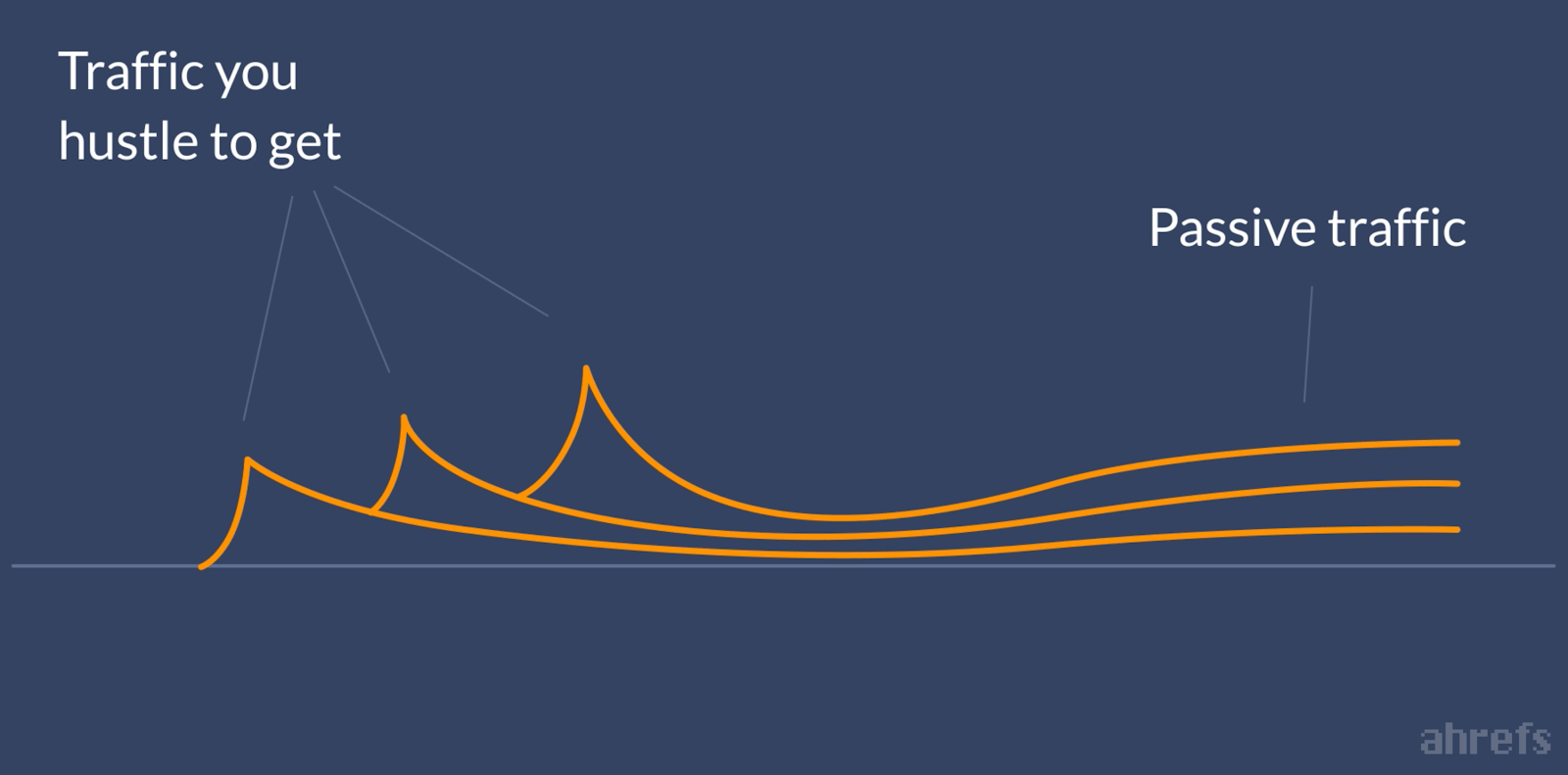
This not only helps attract a steady stream of potential clients but also positions your firm as a trusted, long-term resource in workers’ compensation law.
Some content ideas that can be both immediately helpful and have long-term value include:
- Step-by-step guides on filing a workers’ compensation claim
- Explanations of common workplace injuries and their typical compensation
- FAQs about workers’ rights and employer responsibilities
- Case studies of successful claims (with client permission)
Remember, the primary goal is to help your audience. By consistently providing valuable, genuine information, you’re not just attracting clients—you’re building a reputation as a trusted authority in your field.
5. Always Think About SEO
Search Engine Optimization (SEO) is crucial for improving your website’s visibility when potential clients search for workers’ comp legal services. Even the most valuable content won’t benefit your firm if it can’t be found.

Here are key SEO principles to keep in mind:
Keyword Research
Finding the right keywords is like hitting the bullseye in the vast archery range of the internet. Begin with specific phrases your potential clients might use, like “workers’ comp attorney help” or “workplace injury legal advice.” Utilize tools like Google’s Keyword Planner to identify terms that have a high search volume but aren’t overly competitive.
On-Page Optimization
- Title Tags & Meta Descriptions: Ensure every page on your site has a unique title tag and meta description that incorporates your keywords.
- Header Tags: Break up your content with H1, H2, and H3 tags, using them to highlight key sections.
- Internal Linking: Increase the time users spend on your site through effective internal linking.
Off-Page SEO
Strive for quality backlinks by engaging with the community and consider a workers compensation leads generation campaign that leads to fruitful results. Building relationships with reputable legal and local business websites can enhance your site’s authority.
Technical SEO
- Ensure fast page loading speeds
- Implement secure browsing (HTTPS)
- Make your site mobile-friendly
Remember, SEO isn’t a sprint; it’s a marathon.
It will take time, but with persistence and adherence to these strategies, you’ll see your law firm rise through the ranks.
Content Marketing Ideas That Attract Workers’ Comp Cases
Content marketing plays an important role in attracting workers’ compensation cases because it allows firms to address the exact questions and concerns potential clients have at the moment they are searching for answers. Unlike general service pages, targeted content helps capture a wider range of search queries and positions your firm as a reliable source of information.
One of the most effective approaches is creating content around common situations and questions. Searches such as “what should I do after a workplace injury,” “can I get workers comp for a back injury,” or “what if my claim is denied” reflect immediate needs. Providing clear, practical answers to these types of questions can bring in users who are earlier in the decision process but likely to require legal help.
Case-specific content is another valuable opportunity. Different types of workplace injuries, such as construction accidents, repetitive strain injuries, or occupational illnesses, can each be addressed through dedicated pages or articles. This allows your firm to appear in search results for more specific queries while demonstrating experience across a range of scenarios.
Location-based content also supports visibility. Combining legal topics with geographic relevance, such as pages focused on specific cities or regions you serve, helps reinforce local SEO efforts and increases your chances of appearing in both organic and map-based searches.
FAQ-style content is particularly useful for workers’ compensation marketing. Short, direct answers to common questions align well with how users search and how search engines present information. This format can also improve your chances of appearing in featured snippets or AI-generated summaries.
Consistency is key. Publishing content regularly, updating existing pages, and ensuring accuracy over time signals reliability to both users and search engines. Content should not be created for volume alone, but rather to address real questions in a clear and helpful way.
When executed properly, content marketing supports every stage of the client journey. It attracts users, builds trust, and guides them toward taking the next step, whether that is contacting your firm or requesting a consultation.
6. Budget for Paid Search Marketing
Paid search marketing, particularly Google Ads, can quickly boost your visibility to potential clients searching for workers’ comp lawyers. Here’s why you might consider this strategy:
| Pros | Cons |
|---|---|
|
|
Consider paid search when you need quick visibility or are entering a new market. It’s particularly useful for newer firms or those looking to expand their practice areas.
💡 Expert Tip: Focus on SEO first for long-term credibility and cost-effectiveness. Once your organic presence is established, integrate paid advertising for immediate visibility in competitive areas.
Should Workers’ Comp Lawyers Invest in Paid Advertising?
Paid advertising can be a powerful way for workers’ compensation law firms to generate leads quickly, but it needs to be approached with a clear understanding of costs, competition, and expected outcomes. Unlike organic strategies that build over time, paid channels can deliver immediate visibility, placing your firm in front of potential clients at the moment they are searching for help.
Google Ads is typically the primary platform used in this space. It allows firms to appear at the top of search results for high-intent keywords such as “workers comp lawyer” or “work injury attorney near me.” However, these keywords are highly competitive, and cost-per-click rates can be significant. Without proper campaign structure, targeting, and tracking, it is easy to spend budget without generating consistent returns.
Local Services Ads (LSAs) are another option worth considering. These ads appear above traditional search ads and are designed specifically for service-based businesses, including legal services. LSAs often operate on a pay-per-lead model rather than pay-per-click, which can make them more predictable from a cost perspective. They also include trust signals such as “Google Screened” badges, which can improve click-through rates.
The key advantage of paid advertising is speed. Firms can start generating enquiries almost immediately after launching a campaign. This makes it particularly useful for firms looking to increase case volume in the short term or test new markets. It also provides valuable data on which keywords and messages are driving the most engagement.
However, paid advertising should not be viewed as a standalone solution. Relying solely on ads can lead to rising acquisition costs over time, especially in competitive markets. Combining paid campaigns with strong organic visibility helps create a more balanced and sustainable strategy. While ads capture immediate demand, SEO and content marketing build long-term authority and reduce dependency on paid traffic.
Success with paid advertising ultimately depends on careful management, clear tracking, and ongoing optimisation. When used strategically, it can complement other marketing efforts and play a significant role in driving consistent, high-quality leads.
How Intake and Follow-Up Impact Your Marketing ROI
Marketing does not end when a lead comes in. For workers’ compensation law firms, the way enquiries are handled after the initial contact can have a direct impact on how many cases are ultimately signed. Even the most effective marketing strategy can underperform if intake and follow-up processes are not properly managed.
Speed is one of the most important factors. Potential clients often reach out to multiple firms, and the first one to respond has a clear advantage. Calls that go unanswered or form submissions that sit for hours without a response can quickly turn into lost opportunities. Ensuring that calls are answered promptly and that online enquiries receive a timely reply can significantly improve conversion rates.
Consistency in communication also matters. Every interaction, whether by phone, email, or message, should provide clear, helpful information and reinforce confidence in the firm. Clients are often dealing with stress and uncertainty, and a professional, reassuring response can influence their decision to move forward.
Tracking and accountability are essential for understanding performance. Without proper tracking in place, it is difficult to know how many leads are being generated, how they are being handled, and how many convert into signed cases. Call tracking systems, form tracking, and basic CRM tools can provide visibility into this process and help identify areas for improvement.
Follow-up processes should also be structured. Not every lead will convert on the first interaction, but timely and appropriate follow-up can keep your firm top of mind. This might include returning missed calls quickly, following up on incomplete enquiries, or providing additional information when needed.
There is also a financial impact to consider. Missed calls, delayed responses, and inconsistent handling of enquiries can result in lost revenue that far exceeds the cost of marketing itself. Improving intake processes is often one of the most efficient ways to increase return on investment without increasing marketing spend.
By aligning intake and follow-up with your marketing efforts, you ensure that the leads you generate have the best possible chance of turning into real cases. This creates a more effective and sustainable approach to growth.
7. Integrate Traditional with Digital Advertising
While we’ve focused on digital strategies, successful workers’ comp lawyers know not to abandon effective traditional methods.
Many potential clients, especially older workers or those in certain industries, still respond well to conventional advertising.
Effective traditional tactics include:
- Local radio ads
- Targeted direct mail campaigns
- Community event sponsorships
- Print ads in industry-specific publications
The key is to integrate these traditional methods with your digital strategies. For example:
- Use QR codes in print ads linking to your website
- Mention social media handles in radio spots
- Create digital landing pages for direct mail campaigns
- Live-stream sponsored community events on social platforms
This approach broadens your reach and reinforces your message across channels.
It connects with both older clients who prefer traditional media and younger, digitally-savvy ones.
Combining traditional and digital methods helps you attract more workers’ comp clients, regardless of how they prefer to receive information.
8. Don’t Forget to Track and Analyze Marketing Efforts
As you implement the various marketing strategies we’ve discussed, remember that your work isn’t done once the campaigns are launched. Consistently tracking and analyzing their effectiveness is crucial for optimizing your return on investment.
Consider creating a simple dashboard to monitor key metrics and track your progress against set goals:
| Metric | Goal | Current |
|---|---|---|
| Website Traffic | 5,000/month | 4,200/month |
| Lead Generation | 100/month | 85/month |
| Client Acquisition Cost | $500 | $600 |
| Conversion Rate | 3% | 2.5% |
Use tools like Google Analytics to populate and regularly review this dashboard.
Analyze which strategies are working and adjust accordingly. This data-driven approach allows you to:
- Optimize budget allocation
- Improve client targeting
- Enhance overall strategy
Remember, successful marketing is an ongoing process. Stay informed, flexible, and ready to refine your approach based on these insights to effectively grow your workers’ comp practice.
Common Mistakes Workers’ Comp Law Firms Make with Marketing
Many workers’ compensation law firms invest in marketing but struggle to see consistent results. In most cases, the issue is not a lack of effort, but a series of common mistakes that limit performance and reduce return on investment.
One of the most frequent issues is relying too heavily on referrals alone. While referrals can be valuable, they are often inconsistent and difficult to scale. Firms that do not build a strong online presence miss out on a large volume of potential clients who are actively searching for legal help.
Another common mistake is neglecting local SEO. Workers’ compensation clients typically look for lawyers in their immediate area, and firms that do not optimise their local presence can struggle to appear in relevant searches. This includes incomplete Google Business Profiles, inconsistent business information across directories, and a lack of localised content on the website.
Website performance is also often overlooked. A site that is slow, difficult to navigate, or unclear in its messaging can cause users to leave before taking action. Even small usability issues, such as hard-to-find contact information or complicated forms, can reduce conversion rates.
Some firms invest in paid advertising without proper tracking or strategy. Without clear data on which campaigns are generating leads and which are not, it becomes difficult to optimise spend. This can lead to high costs without a clear understanding of return.
Inconsistent content is another limiting factor. Publishing a few articles or updating the site occasionally is not enough to build authority or maintain visibility. A more structured approach to content, focused on relevant topics and regular updates, tends to produce better long-term results.
Finally, many firms overlook the importance of lead handling. Missed calls, delayed responses, and lack of follow-up can result in lost opportunities, even when marketing is generating interest. Without a clear intake process, valuable leads may never turn into signed cases.
Avoiding these common mistakes allows firms to get more value from their marketing efforts and build a more reliable pipeline of workers’ compensation cases over time.
9. Consider Help From a Legal Marketing Expert

As your practice grows, balancing marketing efforts with legal work can become challenging. A legal marketing expert can be valuable when you’re stretched thin or not seeing desired results from your current strategies.
Look for professionals who:
- Understand the workers’ comp field
- Have a proven track record in legal marketing
- Use data-driven approaches
Many lawyers hesitate to seek marketing help, fearing high costs or loss of control.
However, the right expert can actually save time and resources by implementing targeted, effective strategies. They bring specialized knowledge that can enhance your marketing efforts and potentially increase your ROI.
Whether you choose to work with an expert or continue managing your marketing in-house, the key is to stay focused on reaching and helping the clients who need your services most.
Streamline Your Digital Marketing Efforts with Constellation
With years of experience in legal marketing, here at Constellation, we understands the unique challenges workers’ comp lawyers face.
Our law firm SEO services are designed to help you rank higher in search results, attract more leads, and grow your client base. We’ve also helped numerous firms increase their client base through:
- Targeted local SEO strategies
- Customized content that addresses common workers’ comp concerns
- Effective PPC campaigns focused on high-intent keywords
- Strategic social media management to build trust and authority
Our data-driven approach ensures your marketing budget is used efficiently, maximizing your reach to potential clients.
Ready to elevate your workers’ comp practice?
Schedule a free consultation and discover how we can boost your firm’s visibility.
How Long Does It Take to See Results from Workers’ Comp Marketing?
The timeline for seeing results from workers’ compensation marketing depends on the strategies being used, the level of competition in your market, and the current state of your online presence. While some channels can produce immediate results, others require consistent effort over time to build momentum.
Search engine optimisation (SEO) is a long-term strategy. Most firms begin to see measurable improvements in visibility and traffic within three to six months, but stronger results typically develop over a longer period. Factors such as website authority, content quality, and competition can influence how quickly rankings improve.
Content marketing follows a similar timeline. Creating useful, relevant content helps attract users and build trust, but it often takes time for that content to gain visibility in search results. As more content is published and existing pages are updated, the cumulative effect becomes more noticeable.
Paid advertising, on the other hand, can generate leads almost immediately. Once campaigns are set up and running, firms can begin receiving enquiries within days. However, performance depends on proper targeting, budget allocation, and ongoing optimisation to ensure consistent results.
Local SEO improvements, such as optimising your Google Business Profile and increasing review activity, can show results more quickly than broader SEO efforts. In some cases, firms may see improvements in local visibility within a few weeks, particularly if their current presence is limited.
It is important to approach marketing with realistic expectations. Quick wins are possible through paid channels and local optimisation, but sustainable growth typically comes from a combination of strategies working together over time. Consistency, tracking, and ongoing refinement are key to achieving reliable results.
By understanding how different channels perform over time, law firms can make more informed decisions about where to invest and how to balance short-term lead generation with long-term growth.
Frequently Asked Questions
Optimizing your website with SEO is crucial. Start by incorporating keywords related to workers’ comp law into your content to improve search rankings.
Content marketing is invaluable. Regularly updating your blog with articles on workers’ comp rights and tips can establish your authority and keep your audience engaged.
Absolutely. Platforms like LinkedIn and Facebook allow you to share case successes and legal insights, connecting directly with potential clients.
Consistency is key. Aim to post new content weekly and update your website regularly to reflect any changes in your practice or the law.